
Duplex Classic Quick Take
The Zpacks Duplex Classic is the tent that more or less defined the modern ultralight thru-hiking shelter, and it is still the one most other two-person DCF tents get measured against. It is built for thru-hikers and ounce-counting backpackers who already carry trekking poles and want the lightest functional two-person shelter they can buy. The standout strength is the weight-to-livability ratio: well under 18 ounces for a fully enclosed tent that genuinely sleeps two adults side by side. The main tradeoff is that it asks something of you in return, namely a fussier pitch than a freestanding tent and the usual single-wall condensation you have to manage.
Pros
- Exceptionally light for a fully enclosed two-person tent, around 17.8 oz before stakes
- Genuinely roomy for two, palatial for one, with a tall 48 inch peak
- Waterproof DCF that does not sag, stretch, or absorb water weight
- Taped seams out of the box, so no seam sealing chore
Cons
- Expensive at $749, and stakes are not even included
- Single-wall design means you will manage condensation
- Mesh-heavy walls can feel drafty in hard, cold wind
- DCF does not pack down small and the pitch has a learning curve
Bottom line: $749, roughly 17.8 oz trail weight, sleeps two. If you carry poles and want the benchmark ultralight two-person tent, this is still it.
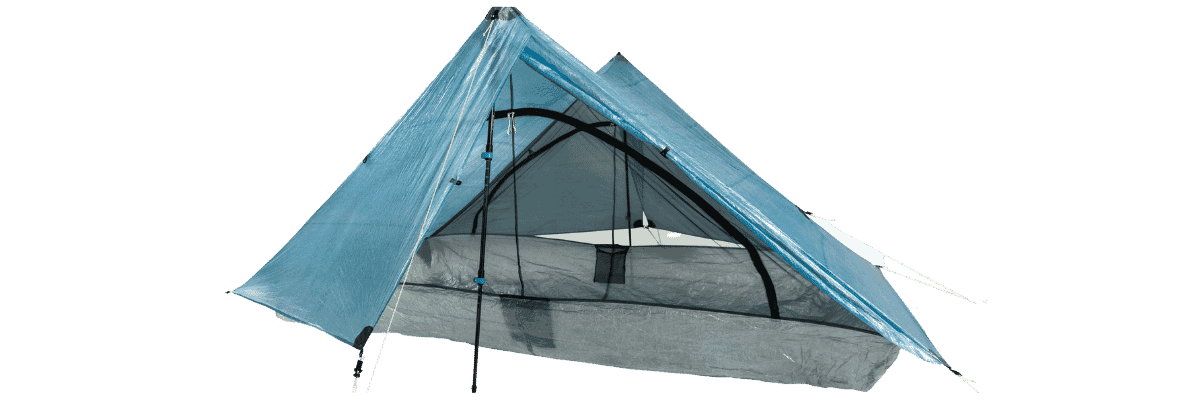
Specs at a Glance: Duplex Classic
| Spec | Detail |
|---|---|
| Price (USD) | $749 |
| Trail Weight | 504 g / 17.8 oz (Olive Drab or Blue, .55 oz/sqyd canopy); 566 g / 19.96 oz (Spruce Green, .75 oz/sqyd canopy). Includes guylines, sewn linelocs, and taped seams. Excludes stakes. |
| Packed Weight | Approximately 522 g / 18.4 oz with included stuff sack, repair tape, and spare zipper sliders (~17.5 g of extras). Excludes stakes and poles. |
| Capacity | 2 person |
| Floor Dimensions | 90 in x 45 in / 229 cm x 114 cm (interior) |
| Peak Height | 48 in / 122 cm |
| Packed Size | Rolled tight: 4.75 in dia x 12 in / 12 cm x 30.5 cm (~3.5 L). Included stuff sack is larger at 7 in x 13 in. |
| Shelter Type | Single-wall, non-freestanding trekking pole tent (semi-freestanding with optional Flex Kit) |
| DCF Canopy Weight | .55 oz/sqyd (Olive, Blue) or .75 oz/sqyd (Spruce Green) |
| DCF Floor Weight | 1.0 oz/sqyd |
| Number of Doors | 2 (each with a screen door plus overlapping storm door) |
| Number of Vestibules | 2 (24 in / 61 cm deep each) |
| Wall Construction | Single-wall DCF canopy, .67 oz/sqyd insect netting, 8 in bathtub floor wall, canopy pitched 6 in off ground |
| Season Rating | Not specified by manufacturer (widely regarded as a 3 season shelter) |
| Trekking Poles Required | Yes, 2 poles at 48 in / 122 cm (or buy carbon tent poles, or the Flex Kit) |
| Warranty | 2 year limited warranty against defects in materials or workmanship |
| Lead Time | Ships in 1 to 3 business days |
Zpacks Duplex Classic Design and Build Quality
The Duplex is a six-panel, symmetrical A-frame made almost entirely of Dyneema Composite Fabric, the laminated, non-woven sailcloth that built Zpacks’ reputation. The canopy comes in two weights: a .55 oz/sqyd DCF for the Olive and Blue versions, and a thicker, more opaque .75 oz/sqyd DCF for Spruce Green. The floor is a tougher 1.0 oz/sqyd DCF in all versions. That floor matters, because DCF is inherently waterproof with no coating to wear out, so it does not need a separate groundsheet for normal use.
Build details are where the price starts to make sense. Seams are taped and tie-outs are bonded from the factory, so there is no seam sealing to do yourself. Guylines are bright yellow 1.6 mm Z-Line cord, pre-cut and pre-attached, with sewn-in LineLoc V tensioners so you can dial the pitch. The screen doors use #3 YKK rainbow zippers, and crucially, the field-replaceable sliders come with spare sliders and repair tape in the box.
One smart, weight-saving choice: the storm doors have no zippers at all. They overlap and close with lightweight toggles, which removes the most common long-term failure point on a DCF tent. The bathtub floor sits 8 inches high with the canopy overhanging it by 4 to 5 inches. None of this is flashy, but every gram is accounted for, and that restraint is the point.
Setup and Pitch of the Duplex Classic
For a tent this light, the Duplex lives surprisingly large. The interior floor is 90 inches long by 45 inches wide, with a tall 48 inch peak height. That 45 inch width is the headline number for couples: it fits two adults on standard-width pads side by side with a little wiggle room, and the symmetrical design means you can both lie in either direction.
The tall, near-vertical center also means two people can sit upright side by side without their heads brushing the canopy, which is rare at this weight. Solo, the Duplex feels like a palace, with a full vestibule on each side for packs, wet shoes, and cooking shelter, each vestibule running 24 inches deep.
Tall sleepers should pay attention here. Zpacks rates the Duplex Classic for users up to about 6 feet 2 inches, and at the upper end your bag will want to brush the angled end walls. The fix is to either sleep diagonally or add 32 inch poles and trekking pole cups at the ends to lift the end walls, though that is an extra purchase and a fussier pitch. If you are taller than that or just want more headroom, Zpacks points toward its taller Pivot Duo instead. Side sleepers do fine given the width. Storage is handled by mesh pockets near each door, positioned so you can reach them from inside or outside.
Weather Performance of the Zpacks Duplex Classic
The Duplex pitches with two trekking poles set to 48 inches and 6 to 8 stakes, which are sold separately. The basic sequence is quick once you know it: stake the four corners, raise the front pole and stake its peak line, raise the back pole, then stake the two side wall tie-outs. An experienced user can have it up in a few minutes.
That said, be honest with yourself about the learning curve. This is the part of the Duplex that frustrates beginners, and almost every long-term review says the same thing. Unlike a freestanding tent you can stand up and then move, a trekking pole tent has to be staked taut from the start, and getting a clean, wrinkle-free pitch takes practice.
Here DCF actually helps you. Because Dyneema does not stretch, a Duplex you pitch tight at bedtime stays tight all night, even after it gets wet, whereas silnylon tents sag and need a midnight re-tension. The flip side is that DCF is unforgiving of a sloppy pitch, since there is no stretch to absorb your mistakes, so a bad stake placement shows up as a flappy wall rather than quietly stretching out. On hard or uneven ground you may need to drop the pole height slightly or use rocks on the stakes, and Zpacks notes pole tips are expected to sink an inch or so into soft ground. For platform or rocky sites where stakes will not hold, the optional Flex Kit makes it semi-freestanding.
Zpacks Duplex Classic Value and Comparisons
For rain, the Duplex is genuinely excellent. DCF is inherently waterproof with no coating to degrade, the seams are taped, and it does not absorb water or sag, so it sheds storms reliably and stays taut through them. The 8 inch bathtub floor plus the canopy overhang keeps splash-up and runoff out, though on hard-packed ground in heavy rain Zpacks recommends camping on leaves or pine needles to cut splash.
Wind is more nuanced. Zpacks says the fabric itself can handle high wind loads and that as long as your stakes hold, the tent stays standing, and field reviews back up its stability when pitched well and oriented correctly, with the overlapping storm door end facing upwind. The recurring real-world complaint is not collapse but draft: the liberal use of perimeter mesh means cold wind can work its way in, so in exposed, cold, windy conditions it can feel breezier than a double-wall tent.
Condensation is the classic single-wall tradeoff, and the Duplex is no exception. There is no separate inner tent, so on cold, still, humid nights moisture will collect on the inner canopy and you need to manage it. Ventilation comes from the full perimeter mesh and from leaving at least one downwind storm door open, which the overlapping doors allow even in rain. The Duplex Classic does not have the dedicated peak vents or zippered storm doors of the pricier Duplex Pro, so airflow management is more manual. Storm mode is simply closing all four doors with the toggles.
Duplex Classic Value and Comparisons
At $749 the Duplex Classic is a serious investment, so the real question is how it stacks up against the small field of tents that can actually compete with it.
Hyperlite Mountain Gear Unbound 2P ($699, about 24 oz). The Unbound is the closest philosophical rival and the obvious upgrade-feature alternative. It is heavier than the Duplex Classic by several ounces, but you get fully zippered, waterproof storm doors, magnetic toggles, peak vents, and a slightly wider footprint. The tradeoff is straightforward: choose the Unbound if you want premium storm-door convenience and venting and will trade weight for it, and choose the Duplex Classic if shaving every ounce and keeping the design simple matters more than zippers and vents.
Durston X-Mid Pro 2 (around $679, roughly 19.6 oz). Durston’s DCF tent is the value-and-design-forward pick. It is competitively light, often praised for an easier, more idiot-proof pitch thanks to its offset pole geometry, and it usually undercuts the Duplex on price. The Duplex counters with a longer track record, a symmetrical interior some couples prefer, and the Zpacks support and repair ecosystem. Pick the X-Mid Pro 2 if pitch simplicity and price are your priorities; pick the Duplex if you want the proven thru-hiker default.
Tarptent Double Rainbow Li (heavier, near 29 oz). This is the choice for people who want DCF weather protection with more forgiving, near-freestanding setup and do not want to be as weight-obsessed. It is noticeably heavier, so it is really for backpackers who value setup ease over the absolute lowest pack weight.
Who should buy the Duplex over these? The thru-hiker or long-distance backpacker who already hikes with poles, counts grams seriously, and wants the most established, widely supported ultralight two-person tent on trail. If you want creature comforts like zippered vestibules and vents, the Unbound earns its weight. If you want an easier pitch for less money, look hard at the X-Mid Pro 2. If you want the lightest simple two-person DCF tent with a proven reputation, the Duplex Classic is still the answer.
Duplex Classic by Zpacks FAQ
Does the Zpacks Duplex hold up in heavy rain?
Yes. The DCF is inherently waterproof with taped seams and no coating to wear out, and because it does not stretch, it stays taut and sheds water well through a storm. The 8 inch bathtub floor and overhanging canopy keep splash and runoff out, especially if you camp on a soft surface rather than hard-packed dirt.
Is the Duplex good in high wind?
It is stable in wind when pitched tight and oriented with the overlapping storm-door end upwind, and Zpacks says it will stand as long as your stakes hold. The common complaint is drafts rather than failure, since the perimeter mesh lets cold wind seep in, so it can feel breezier than a double-wall tent in exposed cold conditions.
Is the Zpacks Duplex hard to set up?
It has a real learning curve, especially if you are coming from freestanding tents. Once you know the corner-then-poles sequence it goes up in minutes, but getting a clean, taut pitch takes practice because DCF does not stretch to hide mistakes.
Do I need trekking poles for the Duplex Classic?
The standard pitch uses two poles set to 48 inches, so if you do not hike with trekking poles you will need to buy Zpacks’ carbon tent poles or the Freestanding Flex Kit. The Flex Kit also makes the tent semi-freestanding for platforms and rocky sites where stakes will not hold.
Is the Duplex a 4 season tent?
Zpacks does not assign a formal season rating, and it is generally treated as a 3 season shelter. The heavy use of mesh and the open perimeter make it breezy in cold weather, so it is not built for serious winter or alpine storm use.
How bad is condensation in the Duplex?
As a single-wall tent, it will collect condensation on cold, still, humid nights, and there is no inner wall to keep that moisture off you. You manage it by venting, namely leaving at least one downwind door open, which the overlapping storm doors allow even in light rain.
Will the Duplex fit a tall person?
Zpacks rates it for users up to about 6 feet 2 inches. Right at that height your sleeping bag will tend to brush the angled end walls, so taller hikers either sleep diagonally, add 32 inch end poles with trekking pole cups to lift the walls, or step up to the taller Pivot Duo.