
Unbound 2 Quick Take
The HMG Unbound 2 is Hyperlite Mountain Gear’s answer to the Zpacks Duplex, and it’s aimed squarely at thru-hikers and serious backpackers who want a fully enclosed DCF shelter without giving up creature comforts. The standout strength is build quality: zippered storm doors, magnetic toggles, peak vents, ten reinforced tie-outs, and HMG’s signature obsessive construction. The main tradeoff is that you’ll pay a premium and still carry a couple of ounces more than the lightest DCF tents on the market.
Pros
- Premium DCF construction with taped seams and reinforced tie-outs
- Roomy 48-inch wide floor and 48-inch peak height
- Zippered vestibules with magnetic toggles and dedicated peak vents
- Symmetrical pitch with only two trekking poles required
Cons
- Expensive at $775 (Spruce Green runs $795)
- Single-wall design means you manage condensation actively
- Measured weights from independent testers often run 1.5 to 2 oz over the listed 22 oz
- DCF doesn’t pack as small as silnylon or silpoly competitors
Bottom line: A $775, 22-oz, fully enclosed two-person DCF shelter that punches above its weight class for livability and detail work.
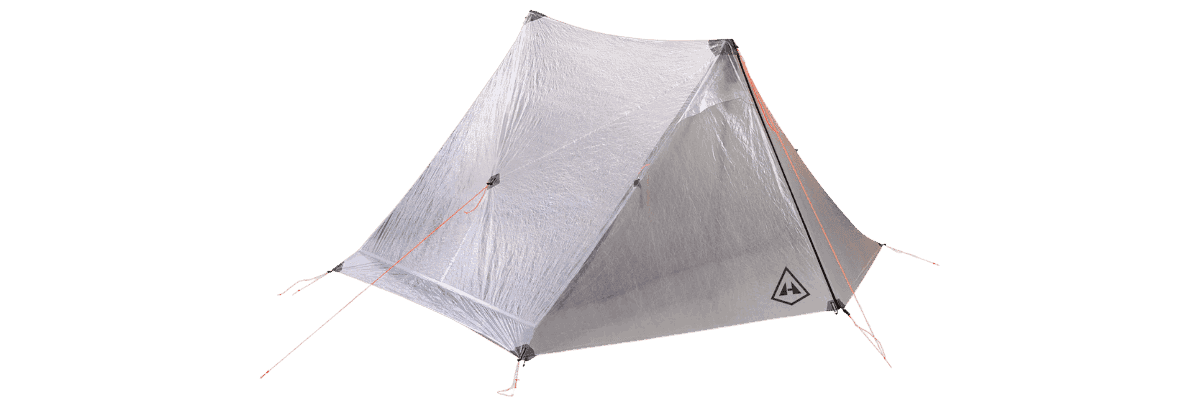
Specs at a Glance: Unbound 2
| Spec | Value |
|---|---|
| Price (USD) | $775 (White) / $795 (Spruce Green) |
| Trail Weight | 624 g / 22 oz |
| Packed Weight | Not specified by manufacturer (independent measured ~26 oz with stuff sack) |
| Capacity | 1 to 2 people |
| Floor Dimensions | 90 x 48 in / 228.6 x 121.9 cm |
| Peak Height | 48 in / 122 cm |
| Packed Size | 8.5 x 6.0 x 5.5 in / 21.6 x 15.2 x 14.0 cm (manufacturer; independent testers report larger) |
| Shelter Type | Single-wall, fully enclosed, trekking-pole-supported A-frame |
| DCF Canopy Weight | 0.55 oz/sqyd |
| DCF Floor Weight | 0.96 oz/sqyd |
| Number of Doors | 2 (No-See-Um mesh inner + zippered DCF outer) |
| Number of Vestibules | 2 |
| Wall Construction | Single-wall DCF with 3D side panels |
| Season Rating | 3-season |
| Trekking Poles Required | Yes, two poles at 125 cm / 48 in (120 cm +/- 5 cm) |
| Warranty | Lifetime guarantee against manufacturing defects |
| Lead Time | In stock, ready to ship (per manufacturer site) |
HMG Unbound 2 Design and Build Quality
This is where the Unbound 2 earns its sticker price. The canopy uses 0.55 oz/sqyd DCF and the bathtub floor steps up to 0.96 oz/sqyd, which is standard issue for premium DCF shelters and the same recipe Zpacks uses on the Duplex. Hyperlite factory tapes every seam, so seam sealing is not on your to-do list. That alone saves a weekend of finicky work compared to most silnylon tents.
The features list is where HMG separates itself from the original Duplex pattern. You get two #3 YKK Aquaguard zippered vestibule doors with magnetic toggles, opposing No-See-Um mesh interior doors with their own #3 YKK zippers, and dedicated peak vents made of DCF5 and DCF10 to manage moisture. The magnetic clasps make it easy to roll up a door and have it actually stay open, which sounds minor until you’ve fumbled with toggles in a downpour.
Ten reinforced tie-outs are spread around the shelter: four at the corners, two at the peaks, two on the vestibules, and two mid-panel. Guylines are 2mm Lawson Ironwire, which is high-visibility, holds a knot well, and doesn’t tangle the way thinner cord does. You get two internal mesh pockets and three ridgeline gear loops. The hardware throughout, from the linelocs to the corner reinforcements, feels engineered rather than cobbled together. This is what justifies the premium over cheaper trekking-pole tents.
Setup and Pitch of the Unbound 2
The Unbound 2 gives you a 90 x 48 inch bathtub floor and a 48 inch peak height, which puts it among the more livable trekking-pole shelters on the market. The 48-inch width is three inches wider than the Zpacks Duplex, and that extra space is noticeable when you’re sharing the tent with another person or a dog.
The 48-inch peak lets most people sit upright comfortably. If you’re 6 feet tall, you’ll have room to dress, eat, and ride out an afternoon storm without hunching. Side sleepers and tall sleepers handle this tent well, though anyone over 6’2″ should expect their head or feet to brush the angled end walls. Hyperlite’s 3D side panels add real headroom and shoulder room you don’t get from a flat A-frame, which matters when two people are squeezed in.
The two vestibules are large enough to stash a 50L pack on each side along with boots and a wet rain layer. Dual side doors mean nobody is climbing over their partner to get out at 2 a.m., which is one of the most underrated features of any two-person shelter.
Interior storage is minimal: two mesh pockets and three ridgeline loops. That’s it. If you like dedicated spots for a headlamp, glasses, and your phone, you’ll want to bring a small gear loft or rig something with cord. This is consistent with the ultralight ethos but worth flagging if you’re coming from a more feature-rich freestanding tent.
Weather Performance of the HMG Unbound 2
The Unbound 2 sets up with two trekking poles at 125 cm (48 inches), give or take 5 cm. Hyperlite spec’d it at 120 cm but you have wiggle room. If your poles don’t extend that far, plan to buy HMG’s carbon fiber tent pole accessory or pick different poles.
A clean pitch takes eight stakes minimum (four corners plus four guy-outs), with two more for the optional peak tie-outs if conditions call for it. Once you’ve practiced the sequence, you can be staked out and taut in under five minutes. The learning curve is real for first-timers, but it’s gentler than odd-angle shelters like the X-Mid because the Unbound’s footprint is a clean rectangle. Stake the four corners square first, raise the poles, then tension the guy-outs.
Here’s the honest reality of DCF: the fabric does not stretch. That’s a feature when it’s pouring rain and your silnylon-owning buddies are out at 3 a.m. retensioning. It’s a curse on uneven ground, because there’s no give to absorb sloppy stake placement. A bad pitch stays a bad pitch until you reset stakes. Find a flat-ish site, get your corners right, and the tent rewards you with a drum-tight pitch that holds for days.
For beginners, this is not the hardest trekking-pole tent to learn, but it’s not the easiest either. The X-Mid Pro 2’s four-stake minimum pitch is more forgiving for first-timers. Plan to set the Unbound up in your backyard two or three times before you trust it on a trip.
HMG Unbound 2 Value and Comparisons
The Unbound 2’s reputation for weather performance is well earned, and there’s a reason HMG markets this thing for harsh conditions. The A-frame profile sheds wind well when oriented correctly (pitch with a narrow end into the wind). Independent testers in Washington’s Alpine Lakes Wilderness and on the Appalachian Trail have reported stable performance in sustained winds and storms, though HMG does not publish a specific mph rating.
Rain shedding is excellent. DCF is 100% waterproof at the fabric level with no PU coating to wear out, and HMG’s factory-taped seams mean water has nowhere to sneak in. The bathtub floor wraps up 8 inches on all sides, which is tall enough that wind-blown rain along the perimeter stays outside.
Condensation is the asterisk on every single-wall shelter, and the Unbound 2 is no exception. The two dedicated peak vents help, and the small gap between the bathtub and the canopy creates a chimney effect that moves air. In dry desert conditions, testers report minimal condensation. In humid forest or coastal environments, expect interior moisture on the canopy by morning, especially if you keep the doors zipped against rain. You manage this by venting aggressively when you can, and by accepting that you might brush against a damp ceiling.
For storm mode, close the vestibule zippers, drop the magnetic toggles, and run all 10 tie-outs. The shelter buttons up tight, and the wide floor plan means you’ve got room to wait out weather in relative comfort.
Unbound 2 Value and Comparisons
At $775, the Unbound 2 sits right in the middle of the premium DCF tent market. Two competitors define the alternatives:
Zpacks Duplex Pro ($699 to $799 depending on color, ~20.4 oz) is the direct competitor and the design the Unbound was clearly built to challenge. The Duplex Pro is about 2 oz lighter and 3 inches narrower in the floor. Both have zippered storm doors, magnetic toggles, and peak vents now. The Duplex Pro tends to feel more “cottage industry” in finish, while the Unbound feels more refined. Choose the Duplex Pro if every ounce matters and you don’t need the extra width. Choose the Unbound 2 if you want a more polished build, more shoulder room, and a wider floor for a partner or a dog.
Durston X-Mid Pro 2 ($639, ~17.9 to 21 oz depending on measurement) is the value and weight king. It’s lighter, cheaper, and pitches with just four stakes, which makes it more beginner-friendly. The X-Mid’s offset pole geometry creates more usable interior volume despite similar floor dimensions. The tradeoff: the X-Mid’s diamond-shaped footprint can be harder to fit on tight tent pads, and Durston’s release cadence means it’s frequently sold out. Choose the X-Mid Pro 2 if you want the lightest, simplest pitch and the best price-per-ounce ratio. Choose the Unbound if you prefer a rectangular footprint, a more conservative design, and HMG’s customer service and reputation.
The buyer who should pick the Unbound 2 is someone who values build refinement, wants a wider floor for two people or a partner with a dog, and trusts HMG’s reputation for in-house construction and lifetime guarantee. Thru-hikers, long-distance backpackers, and fastpackers who want a durable DCF tent that will go the distance through a 2,000+ mile season are the core audience. If you’re a weight-obsessed soloist or a budget-conscious buyer, look at the X-Mid Pro 2 first.
Unbound 2 by Hyperlite Mountain Gear (HMG) FAQ
Is the HMG Unbound 2 good in heavy rain?
Yes. The 100% waterproof DCF construction and factory-taped seams shed rain reliably, and the 8-inch bathtub floor walls keep splash-back out. Just be aware that condensation in humid conditions is a separate issue from rain, and you’ll need to vent actively.
How does the Unbound 2 handle high winds?
Well, when pitched correctly with the narrow end into the wind and all 10 tie-outs deployed. Field testers report solid performance in Alpine and East Coast storms, though HMG does not publish a specific mph rating. DCF’s no-stretch behavior means the tent holds its shape rather than flapping.
Is the Unbound 2 hard to set up?
It’s moderate. The rectangular footprint and symmetrical design are forgiving compared to odd-angle shelters, but you need to get the four corners square before raising the poles. Plan two or three backyard practice pitches and you’ll be solid by your first trip.
Can I use the Unbound 2 in winter or 4-season conditions?
No. This is a 3-season shelter. The mesh inner doors and the canopy-to-floor air gap mean snow and serious cold-weather wind will find their way in. For winter use, look at a 4-season pyramid like HMG’s UltaMid 2 with a full inner.
How tall can I be and still fit in the Unbound 2?
Up to about 6’2″ comfortably, with the tent’s 90-inch floor and angled end walls. Taller sleepers report their head or feet touching the canopy, which becomes a condensation transfer issue more than a fit issue. Sleeping diagonally helps if you’re at the upper end.
Does the Unbound 2 need a footprint?
Not strictly, since the 0.96 oz/sqyd floor is more durable than the lighter canopy fabric. But many users add a piece of Tyvek or polycro to extend the floor’s life on abrasive ground, especially in granite or desert terrain. A footprint adds a few ounces and significant longevity.
How bad is condensation in the Unbound 2?
It depends entirely on conditions. In dry climates it’s minimal. In humid forest, coastal, or cold-and-wet environments, expect moisture on the interior canopy by morning. The peak vents and floor gap help, but as a single-wall tent there’s no inner wall to absorb condensation away from your sleeping bag.