
Pivot Solo Quick Take
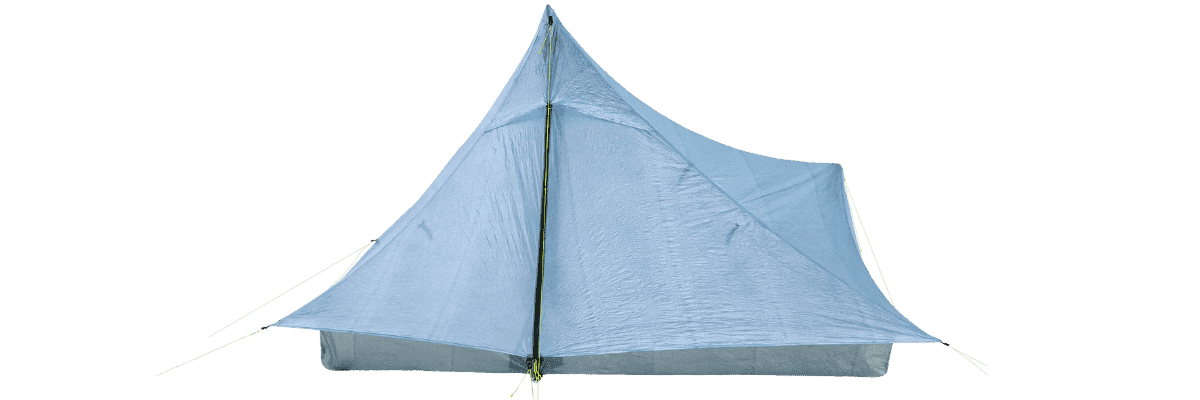
The Zpacks Pivot Solo is built for solo ultralight hikers who want real interior space without crossing the one-pound mark. Its standout feature is the offset rear trekking pole, which pivots away from the foot end to open up serious headroom and shoulder room in a sub-14-ounce shelter. The main tradeoff is pitch complexity. This is not a fast-and-easy tent like a Durston X-Mid, and the wonky asymmetric shape rewards patience with the guylines.
Pros
- Genuinely livable interior for an under-14 oz shelter, fits hikers up to 6’5″
- Two real storm doors with magnet toggles and waterproof zippers
- Small footprint squeezes into tight backcountry sites
- Solid Zpacks build quality with taped seams and field-replaceable zipper sliders
Cons
- Asymmetric pitch takes practice and micro-adjustments to get taut
- Single-wall DCF means active condensation management on humid nights
- Premium price even by DCF standards
- Lite floor option is borderline for thru-hike abuse without care
Bottom line: $649 USD, 13.4 oz trail weight, one-person shelter.
Specs at a Glance: Pivot Solo
| Spec | Value |
|---|---|
| Price (USD) | $649 (Lite) / $649 (Standard, Spruce Green) |
| Trail Weight | 379 g / 13.4 oz (Lite) |
| Packed Weight | 396 g / 14.0 oz (with stuff sack, repair tape, spare sliders) |
| Capacity | 1 person |
| Floor Dimensions | 84 x 28/42 in (214 x 71/107 cm), tapered |
| Peak Height | 52 in front / 32 in rear-right (132 cm / 81 cm) |
| Packed Size | 4 x 11 in rolled tight (10 x 28 cm), 2.3L |
| Shelter Type | Single-wall, non-freestanding, trekking pole |
| DCF Canopy Weight | 0.55 oz/sqyd (Lite) or 0.75 oz/sqyd (Standard) |
| DCF Floor Weight | 0.75 oz/sqyd (Lite) or 1.0 oz/sqyd (Standard) |
| Doors | 1 large L-shaped entry with secondary storm door |
| Vestibules | 1 front vestibule, 8 sqft |
| Wall Construction | Single-wall, taped seams, bonded tie-outs |
| Season Rating | 3-season |
| Trekking Poles Required | Yes, 1x 52 in (132 cm) and 1x 32 in (81 cm) |
| Warranty | 2-year limited |
| Lead Time | Ships in 1-3 business days |
Zpacks Pivot Solo Design and Build Quality
The Pivot Solo’s signature move is geometric. Instead of running the rear pole down the centerline, Zpacks pivots it out to the back-right corner, which dramatically opens up the volume at the foot end where traditional pyramid tents collapse into useless triangle space. The front 52-inch pole and rear 32-inch pole work together to create steep walls front and rear, with a long diagonal ridgeline doing the structural work.
You get two DCF combos. The Lite version pairs a 0.55 oz/sqyd canopy with a 0.75 oz/sqyd floor in Blue or Olive Drab. The Standard version uses a 0.75 oz/sqyd canopy with a 1.0 oz/sqyd floor in Spruce Green and runs heavier at about 450 g. For most three-season use the Lite is durable enough, but if you’re doing a full PCT or AT thru-hike, the Standard floor’s extra mylar layer is the smarter call. CleverHiker came down on the same side after testing both.
Construction details earn the price. All seams are factory-taped, tie-outs are bonded rather than just sewn, and the zippers are YKK Aquaseal waterproof types on both storm doors. LineLoc V adjusters at every guy point let you dial in micro-adjustments without re-staking. The bathtub floor sits 6 inches tall with the canopy pitched 4 inches off the deck, so you get a real splash gap. Zipper sliders are field-replaceable and Zpacks ships the tent with repair tape and two spare sliders in the stuff sack, which is the kind of detail you only appreciate after something fails 80 miles from the road.
Setup and Pitch of the Pivot Solo
This is where the Pivot Solo earns its name. The floor measures 84 inches long with a width that tapers from 28 inches at the head to 42 inches at the widest point, then back to 29 inches at the foot. The 42-inch wide section easily swallows a wide sleeping pad with room for gear alongside, which is rare in a tent under a pound.
Peak height hits 52 inches at the front, which is tall enough to sit up cross-legged without your hair touching the canopy. The rear corner stays at 32 inches because the pole is staked out there, so you have a defined foot-box that won’t collapse onto your sleeping bag. Zpacks rates fit up to 6’5″, and reviewers at SectionHiker and The Trek both confirmed comfortable fit for 6-foot testers with room to spare. If you’re over 6’2″, you’ll appreciate that you can sleep with your head at either end depending on the slope.
The vestibule offers 8 square feet of covered storage, which fits a 65L pack and shoes with no Tetris required. Inside there’s one mesh pocket for headlamp and phone, plus small loops at each peak for a clothesline or gear nest. Side sleepers get adequate shoulder room thanks to the steep walls at the head end. Two-person fit is not on the table here. This is a dedicated solo shelter.
The L-shaped door is the main livability compromise. The arched zipper means mosquitoes can sneak in when you’re entering or exiting in heavy bug pressure, since the mesh doesn’t fall closed by itself the way it does on Durston designs.
Weather Performance of the Zpacks Pivot Solo
Plan on 5 to 8 minutes for your first pitches and 3 to 5 once you’ve got it dialed. The Pivot Solo uses two trekking poles set to specific lengths (52 in front, 32 in rear-right) and 6 stakes minimum, 8 recommended. The corners stake out first, then you insert the front pole through the pin-down flap, stake the front guyline, repeat at the rear-right corner, and finally tension the side wall guyouts.
The pitch is fiddly. Adventure Alan called the geometry “wonky to behold” and noted it requires sidewall guylines plus micro-adjustments to get truly taut. This is the honest knock on the Pivot Solo and the reason Durston fans tend to stay Durston fans. The asymmetric shape means there’s no quick visual reference for “is this right.” You have to walk around the tent, eyeball the canopy for wrinkles, and tweak corner stakes or LineLoc tension until everything snaps tight.
DCF’s zero-stretch property cuts both ways here. Once you nail the pitch, it stays bombproof tight all night, no sagging in dew or rain. But you can’t rely on the fabric to stretch out small pitch errors the way silnylon will. If your front and rear poles aren’t dead-vertical and your corners aren’t pulled to the right tension, you’ll see flapping panels.
On uneven ground the Pivot Solo is forgiving in one dimension and unforgiving in another. The small footprint (about 73 by 98 inches including vestibule) tucks into tight spots silnylon doubles couldn’t fit. But the asymmetric stake pattern means you need five usable stake points roughly where the tent wants them, which can be hard in rocky terrain. This is not a beginner-friendly tent. If you’ve never pitched a trekking pole shelter, start with a Plex Solo or an X-Mid 1 and graduate up.
Zpacks Pivot Solo Value and Comparisons
Once pitched correctly, the Pivot Solo handles weather better than its weight suggests. The diagonal ridgeline and twin-pole structure spread loads well, and multiple reviewers including SectionHiker called it surprisingly wind resistant when staked taut with all eight stakes. Pitch the closed end into prevailing wind and the steep low rear-right corner sheds gusts effectively. Zpacks doesn’t publish a wind rating in mph, but field reports describe it holding up in 30+ mph sustained gusts.
Rain shedding is what you’d expect from DCF, which is to say excellent. DCF is inherently waterproof with no DWR coating to wear out, and Zpacks rates the canopy and floor as fully waterproof from day one with no seam sealing needed. The 6-inch bathtub wall plus the overhanging canopy keep splash-up out, though the manufacturer specifically calls out hard-packed ground as a splash risk and recommends camping on leaves or pine needles when you can.
Condensation is the honest weakness, as it is with every single-wall shelter. The Pivot has a peak vent plus full perimeter mesh and a downwind storm door that can stay open in calm rain, which is genuinely better ventilation than a Plex Solo. But on a cold, still, humid night next to water, you’ll wake up to interior moisture. The bathtub recess and the no-touch geometry at the foot help keep your bag dry from wall brush-off, and the canopy pitches 4 inches off the deck for ground-level airflow. Manage your site selection and you’ll be fine. Camp in the bottom of a damp valley and you’ll be reaching for the pack towel.
Pivot Solo Value and Comparisons
At $649 the Pivot Solo lands in the upper bracket of one-person DCF tents. Three competitors deserve a direct look.
Durston X-Mid Pro 1 (about $599, 15.5 oz, 90 x 32 x 45 in). The X-Mid Pro 1 is the obvious benchmark and currently the most-recommended ultralight one-person DCF tent on long trails. It’s easier to pitch, has two doors and two vestibules, and includes hot-bonded seams. The Pivot Solo counters with about 2 ounces less weight, a 7-inch taller peak, and a smaller footprint. If you camp in tight, rocky, or alpine sites where the X-Mid’s 8-foot length doesn’t fit, the Pivot wins. If you want the simplest possible pitch and don’t mind the extra ounces, the X-Mid wins.
Zpacks Plex Solo Lite ($599, 11.8 oz, 90 x 28/38 x 52 in). The Plex Solo is the lightest fully featured DCF tent on the market. Same 52-inch peak height, slightly longer floor, and a much simpler single-pole pitch. The Pivot trades 1.6 ounces and $50 for noticeably better foot-end room, a real storm door with magnets, and better ventilation. Tall sleepers and anyone who hates a sloping foot box should go Pivot. Weight purists who pitch quickly should go Plex.
Tarptent Aeon Li (about $699, 17.3 oz, 88 x 33 in, 46-inch peak). The Aeon Li uses a single pole strut design with all-DCF construction. It’s faster to pitch than the Pivot but offers less headroom and shoulder room, and it weighs almost 4 ounces more. The Pivot Solo is the better choice for livability per ounce.
Who should pick the Pivot Solo: tall solo thru-hikers and weekend backpackers who want the most interior volume available under 14 ounces, are willing to learn an asymmetric pitch, and already own (or plan to own) two trekking poles. Fastpackers prioritizing setup speed should look at the X-Mid Pro 1 instead. Strict ounce-counters who don’t need the extra foot-end room should look at the Plex Solo Lite.
Pivot Solo by Zpacks FAQ
Is the Zpacks Pivot Solo good in rain and wind?
Yes, once pitched taut. DCF doesn’t stretch or absorb water, so the canopy stays tight all night, and field reports show it handling sustained gusts in the 30+ mph range with all eight stakes deployed. Pitch the closed end into the wind.
How hard is the Pivot Solo to set up?
Harder than most one-person tents. The asymmetric ridgeline and offset rear pole require careful corner staking and micro-adjustments with the LineLocs to get a taut pitch. Expect 5 to 8 minutes early on, dropping to 3 to 5 once you know what you’re doing. Beginners should practice in the backyard before relying on it in weather.
Will the Pivot Solo fit a tall person?
Up to 6’5″ according to Zpacks, and verified by reviewers up to 6’1″ with comfortable room. The 84-inch floor and the vertical rear-right corner mean your feet won’t touch the canopy if you sleep diagonally. Hikers at 6’4″ or taller should still test fit before committing.
Is the Lite floor durable enough for a thru-hike?
It can be, with careful site prep. The 0.75 oz/sqyd Lite floor has handled long-distance hikes, but the more conservative pick for a full 2,500-mile thru-hike is the Standard floor at 1.0 oz/sqyd. A separate groundsheet is not required but adds peace of mind on rocky terrain.
How bad is condensation in the Pivot Solo?
Better than the Plex Solo thanks to the peak vent and large openable storm door, but it’s still a single-wall DCF tent. On cold, calm, humid nights you’ll get interior moisture. Site selection (avoid low spots near water) and leaving the downwind door cracked open are the main management tools.
Do I need both trekking poles to be specific lengths?
Yes. The front pole sets to 52 inches (132 cm) and the rear-right pole sets to 32 inches (81 cm). Most modern adjustable trekking poles cover both. If you don’t hike with poles, Zpacks sells a dedicated 52-inch and 32-inch tent pole separately.
Can the Pivot Solo work as a two-person tent in a pinch?
No. The floor tapers significantly and the 42-inch widest point is only at the diagonal midpoint, not consistent along the length. It’s a true one-person shelter. If you need two-person flexibility, look at the Pivot Duo or X-Mid Pro 2.