
ProTrail Li Quick Take
The ProTrail Li is Tarptent’s simplest and least expensive Dyneema shelter, and it makes the most sense for the trekking pole hiker who wants a real DCF tent without paying flagship money. Its standout strength is the combination of a genuinely low 15.95 oz / 453 g minimum weight, a tiny strut free packed size, and a small footprint that tucks into tight campsites most tents can’t use. The main tradeoff is the front-entry A-frame layout, which means you crawl in over the foot of your pad and live with translucent walls that glow like a paper lantern. If you want side entry or more headroom near your shoulders, you’ll be looking at pricier tents.
Pros
- One of the lowest-cost ways into a USA-made DCF single-wall tent
- Fits hikers up to 6 ft 8 in / 203 cm, which is rare in this weight class
- Fast four-stake pitch with no rigid struts to pack
- Stays drum-taut all night because DCF doesn’t stretch or sag when wet
Cons
- Front entry forces you to climb in lengthwise, awkward for side sleepers used to side-entry tents
- Single-wall DCF means you manage condensation yourself
- The fabric is nearly transparent, so privacy is limited
- One canopy color only, and it requires two trekking poles of specific lengths
Bottom line: a 1-person, 3-season single-wall DCF tent at $499 on sale (regular $599), 15.95 oz / 453 g trail weight, sleeps 1 comfortably.
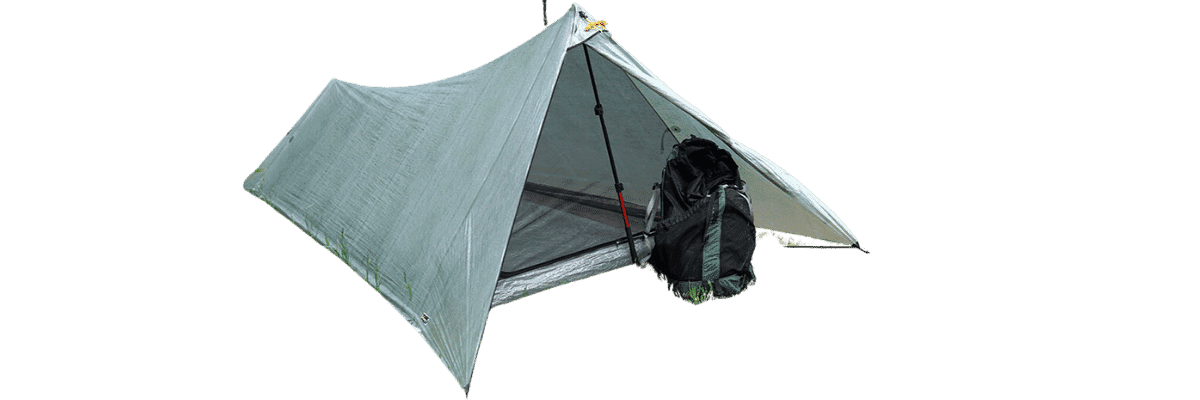
Specs at a Glance: ProTrail Li
| Spec | ProTrail Li |
|---|---|
| Price (USD) | $499 (sale, regular $599) |
| Trail Weight | 453 g / 15.95 oz (body fully corded, Tarptent “minimum weight”) |
| Packed Weight | 523 g / 18.45 oz (with bags and stakes, Tarptent “typical weight”) |
| Capacity | 1 (rated 1+, two in a pinch) |
| Floor Dimensions | 84 in long, 42 in tapering to 30 in wide / 213 cm long, 107 cm tapering to 76 cm wide |
| Floor Area | 21 sq ft / 1.95 sq m |
| Peak Height | 45 in / 114 cm (adjustable) |
| Packed Size | 10 in x 4.5 in / 25.4 cm x 11.5 cm (adjustable) |
| Shelter Type | Single-wall, non-freestanding, trekking pole A-frame |
| DCF Canopy Weight | 0.55 oz/sqyd (CT1E.08), over 8,000 mm HH |
| DCF Floor Weight | 0.96 oz/sqyd (CT2K.18), over 20,000 mm HH |
| Number of Doors | 1 (front) |
| Number of Vestibules | 1 (front, 10 sq ft / 0.92 sq m) |
| Wall Construction | Single-wall with condensation gutters |
| Season Rating | 3-season |
| Trekking Poles Required | Yes, two (or one substitute pole plus a 24 in strut) |
| Warranty | Lifetime against defects in materials and workmanship |
| Lead Time | Not specified (showing out of stock at time of writing) |
Tarptent ProTrail Li Design and Build Quality
The ProTrail Li is an honest A-frame: a Dyneema canopy stretched over a tall front pole and a short rear pole, with a floating bathtub floor connected by mesh. The canopy is 0.55 oz/sqyd DCF (CT1E.08) rated to over 8,000 mm of hydrostatic head, and the floor steps up to tougher 0.96 oz/sqyd DCF (CT2K.18) rated past 20,000 mm. That floor choice matters, because DCF resists puncture and abrasion less gracefully than nylon, so the heavier deck buys you real-world durability where you need it.
Every seam is factory taped, so no seam sealing is required out of the box. The hardware list is where the premium price starts to justify itself: YKK two-way waterproof zippers, DAC aluminum J-stakes, UHMWPE cored reflective guyline with integrated LineLocs, carbon fiber struts at the foot, and magnetic tiebacks for both the front door and the rear storm flap. Magnets sound gimmicky until you’re working frozen fingers at dawn, and reviewers consistently call them out as a genuine convenience.
The build is rounded out with five perimeter hem pullouts, an apex guyline pre-attached for extra storm staking, foot-end load lifters to keep the canopy off your quilt, and condensation-catching gutters along the lower walls. None of this is flashy. It is the kind of detailing that explains why a tent this simple still costs what a respected cottage brand charges.
Setup and Pitch of the ProTrail Li
On paper the ProTrail Li gives you a long 84 in / 213 cm floor and a tapered width of 42 in down to 30 in / 107 cm down to 76 cm, for 21 sq ft of floor area. The headline number for tall hikers is that Tarptent rates it for users up to 6 ft 8 in / 203 cm, and verified owners at 6 ft 2 in to 6 ft 4 in repeatedly report room to spare at head and feet.
The 45 in / 114 cm adjustable peak sits over the front third of the tent, so you sit up comfortably near the door but the ceiling drops toward your feet, as it does in any A-frame. Width is the real constraint. It accommodates pads up to 30 in / 76.2 cm wide, but the walls angle inward, so side sleepers who sprawl will find less elbow room than the floor area suggests. Several owners note the foot-end load lifters and a taut pitch are what keep the canopy off your quilt.
The single front door and 10 sq ft vestibule swallow a pack and shoes, and the front-facing entry turns out to be a quiet win: you can kneel in the doorway to inflate a long pad or cook in the open vestibule without contorting. Storage inside is modest, just one integrated interior pocket plus an overhead clip. Calling it a two-person tent is generous. One person plus gear is the honest read.
Weather Performance of the Tarptent ProTrail Li
This is a fast, four-stake, fly-first pitch, and once you’ve done it a handful of times owners report sub-two-minute setups. You stake the four corners, raise the front trekking pole, set the shorter rear pole, and tension the corners. That’s the whole act.
There is a learning curve, and it’s worth being blunt about it. The ProTrail’s tautness and wind stability depend on near-perfect corner geometry. Get a corner placement off by a few inches and one side won’t pull tight, which is exactly the kind of feedback experienced owners give. Rocky or rooty ground makes this harder because you can’t always stake where the geometry wants you to. Beginners get there quickly, but plan to practice in the backyard before trusting it on a trip.
You need two trekking poles, and the lengths are specific: a tall front pole around 115 cm / 45 in to match the adjustable peak, and a short rear pole around 60 cm / 24 in. If your poles don’t collapse that short, Tarptent sells a substitute pole plus a 24 in strut. The front pole can be angled to widen the doorway.
Here’s the part beginners coming from nylon will love. DCF has essentially no stretch, so the pitch you set is the pitch you keep, even when it rains. No midnight re-tensioning, no sag. The flip side is unforgiving: DCF won’t stretch to hide a sloppy pitch, so your staking has to be right.
Tarptent ProTrail Li Value and Comparisons
The low-profile A-frame is a quietly strong storm shape, and owner reports back that up. One verified buyer rode out strong winds and 2 in of overnight snow on a Montana shakedown with no drama, and multiple reviewers describe it as sturdy and “strong in the wind.” Tarptent doesn’t publish a specific mph rating, so treat wind numbers as anecdotal rather than lab-tested.
Rain shedding is straightforward thanks to taped seams and the over-8,000 mm canopy, with the 20,000 mm floor handling pooling water. The interior stays protected from overhead rain even with the door or storm flap open, which is a meaningful livability detail when you want airflow in a storm.
Ventilation is the design’s strong suit for a single-wall tent. A rear mesh window with an interior storm flap, two-way zippers, and an adjustable pitch height let you run it from to-the-ground storm mode to a raised, breezy setup. The flap can be partly or fully closed as conditions change.
Condensation is the honest weak point, as it is with every single-wall DCF shelter. You will get condensation in the wrong conditions, full stop. The gutters catch and channel some of it, and owners describe a thin film rather than dripping beads, wiped away with a small cloth. Tarptent’s own advice is the right advice: avoid camping in damp low spots, pick breezy elevated sites, and vent aggressively.
ProTrail Li Value and Comparisons
At $599, the ProTrail Li is one of the cheapest doors into a USA-made DCF single-wall tent, and that framing matters more than any single spec.
Versus the Zpacks Plex Solo ($599). The Plex Solo is the obvious cross-shop. It’s lighter (about 13.95 oz for the Classic, 11.8 oz for the Lite version), has no zippers to fail, and uses a single pole instead of two. But it costs more, uses a thinner 0.75 oz Classic or 0.55 oz Lite floor that some buyers baby with a groundsheet, and carries only a two-year warranty against Tarptent’s lifetime coverage. Choose the ProTrail if you value the tougher 0.96 oz floor, a lifetime warranty, and saving a hundred dollars; choose the Plex Solo if shaving every gram and skipping zippers is the priority.
Versus the Tarptent Aeon Li (in-house, side entry). The Aeon Li weighs about the same and pitches with a single pole plus PitchLoc struts, and crucially it offers side entry with more shoulder-area volume. It costs more and packs longer because of those struts, which can foul horizontal-loading packs. Choose the Aeon Li if side entry and a roomier feel near your shoulders are worth the premium; choose the ProTrail Li if you want the lower price and the smaller, strut-free packed size.
Versus the Gossamer Gear The One (silnylon). The One is the value play. It’s a 1-person trekking pole tent in silnylon, roughly 30 percent heavier and roughly half the price. Choose The One if budget is the deciding factor and a few extra ounces don’t bother you; choose the ProTrail Li if you want DCF’s no-stretch, no-sag pitch and the lighter long-term carry, and you’re willing to pay for it.
Who should buy the ProTrail Li over the alternatives: tall solo hikers, thru-hikers, and weight-conscious backpackers who want a durable, lifetime-warrantied DCF tent at the lowest price Tarptent offers, and who don’t mind a front entry or a short practice curve.
ProTrail Li by Tarptent FAQ
Is the Tarptent ProTrail Li good in rain and wind?
Yes for both, within 3-season limits. The taped seams and high-HH fabrics shed rain reliably, and the low A-frame profile has handled strong wind and even light overnight snow in owner reports. Tarptent doesn’t publish a wind speed rating, so think of it as a sturdy 3-season shelter rather than a mountaineering tent.
Is the ProTrail Li hard to set up?
The four-stake pitch is fast once learned, often under two minutes, but it rewards practice. A taut, stable pitch depends on getting the corner placement right, which is trickier on rocky ground. Set it up a few times at home before your first trip.
Does the ProTrail Li have a condensation problem?
It can, like every single-wall DCF tent. Built-in gutters help channel moisture and owners usually see a thin film rather than drips, but in cool, damp, still conditions you’ll need to wipe it down and vent. Camp in breezy, elevated spots to minimize it.
Will the ProTrail Li fit a tall person?
Yes, and this is a genuine strength. Tarptent rates it for users up to 6 ft 8 in / 203 cm, and tall verified owners confirm real room at head and feet. Width tapers toward the foot, so the length is more generous than the shoulder room.
Do I need a footprint for the ProTrail Li?
Not always. The 0.96 oz DCF floor is reasonably tough, but it punctures and abrades more easily than nylon, so a groundsheet is smart on sharp or abrasive ground like sandstone and extends the floor’s life. Many owners use a thin polycryo or Tyvek sheet for peace of mind.
Is the ProTrail Li worth it over a cheaper silnylon tent?
That depends on what you value. DCF buys you a no-stretch pitch that stays taut all night, lower weight, and a tent that won’t sag when wet, but it costs more and is less puncture tolerant. If budget is your top concern, a silnylon tent like Gossamer Gear The One does a similar job for less.
How many trekking poles does the ProTrail Li need, and what length?
Two: a tall front pole near 115 cm / 45 in and a short rear pole near 60 cm / 24 in. If your poles don’t collapse short enough for the rear, Tarptent sells a substitute pole plus a 24 in strut. It is not freestanding and cannot be pitched without poles.