
X-Mid Pro 2+ Quick Take
The X-Mid Pro 2+ is the tent you buy when you and a partner want a genuine two person palace without paying the usual weight penalty. Its standout strength is livable space, a 52 inch wide floor that swallows two wide pads plus a 49 inch peak that lets most people sit upright, all for a trail weight that still starts under 20 ounces. The main tradeoff is footprint. This is a big rectangular tent, so it is harder to wedge into tight or rocky sites than a smaller hexagonal shelter, and like every DCF tent it is expensive.
Pros
- Best in class interior volume and headroom for two people
- Simple four stake pitch that beginners can learn fast
- Full coverage fly, dual peak vents, and strong storm performance
- Fully bonded Dyneema seams and a silnylon floor option that keeps the price down
Cons
- Large rectangular footprint is fussy on uneven or cramped sites
- DCF is loud in wind and the price is steep no matter how you configure it
Bottom line: A roughly $719 (silnylon floor) two person Dyneema shelter with a 19.2 to 21.5 oz trail weight that gives you more usable room than almost anything in its class.
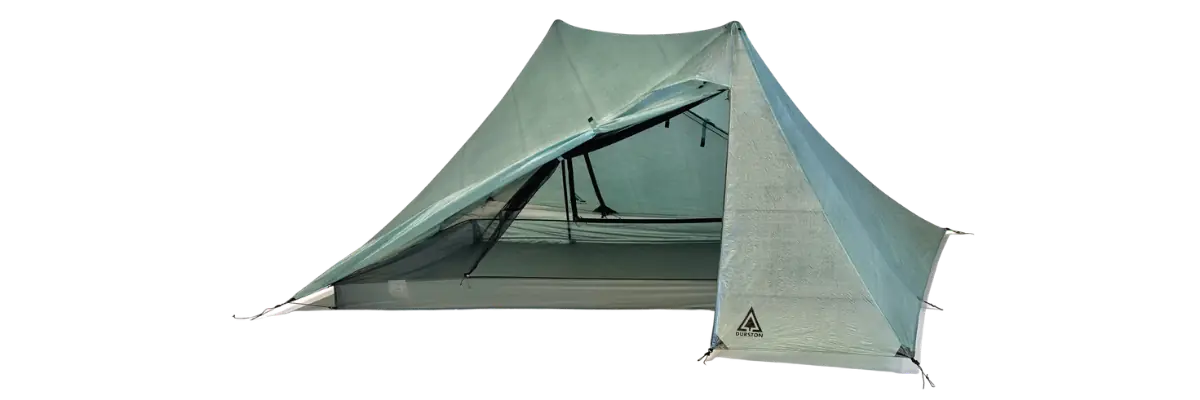
Specs at a Glance: X-Mid Pro 2+
| Spec | Detail |
|---|---|
| Price (USD) | $719 (silnylon/woven floor); about $819 with Dyneema floor |
| Trail Weight (g and oz) | 545 g / 19.2 oz (DCF floor) or 610 g / 21.5 oz (silnylon floor) |
| Packed Weight (g and oz) | Typical setup with sack and 6 stakes: 630 g / 22.2 oz (DCF floor) or about 697 g / 24.6 oz (silnylon floor) |
| Capacity | 2 person (oversized “2+”) |
| Floor Dimensions (L x W) | 90 x 52 in / 229 x 132 cm |
| Peak Height | 49 in / 124 cm |
| Packed Size | 11 x 5.5 in / 27 x 13 cm |
| Shelter Type | Single wall / hybrid, trekking pole supported, double door, double vestibule |
| DCF Canopy Weight | 0.55 oz/sqyd |
| DCF Floor Weight | 0.66 oz/sqyd (Dyneema floor option) |
| Number of Doors | 2 |
| Number of Vestibules | 2 (about 11.6 sq ft each, 23 sq ft total) |
| Wall Construction | Hot bonded Dyneema seams, no sewn seams in the canopy |
| Season Rating | 3 season, stormworthy |
| Trekking Poles Required | Yes, two. The fly sets the correct height, so no measuring needed |
| Warranty | 2 years |
| Lead Time | Not specified (currently listed in stock) |
Durston Gear X-Mid Pro 2+ Design and Build Quality
The X-Mid Pro 2+ scales up Durston’s award winning X-Mid geometry into a larger two person form. The canopy is 0.55 oz/sqyd Dyneema Composite Fabric in spruce green, and you choose between a 15D silnylon floor or a lighter 0.66 oz/sqyd DCF floor. The big build story is the seams. Durston builds these at the most experienced DCF tent factory in the world using hot bonded construction rather than sewing or cold taping, which produces stronger seams that hold their strength better in temperature extremes. Sewn seams are one of the most common failure points on DCF shelters, so eliminating them matters for longevity.
Two more details justify the premium. Durston uses a proprietary pre shrinking process so the Dyneema does not deform or shrink over time, a problem that leaves many DCF tents with wavy zippers after heavy use. The brand also aligns stress lines with the Dyneema fibers or adds tape reinforcement so panels are never loaded diagonally on the bias, which protects the fabric from premature degradation.
Hardware is sensible rather than flashy. You get YKK #3 AquaGuard zippers on the fly and YKK #3 on the inner, magnetic door toggles on both the fly and the inner doors, a tensioned bathtub floor, and peak plus side guyout points for storm mode. Durston pitches each tent twice for inspection before it ships.
Setup and Pitch of the X-Mid Pro 2+
This is the section where the Pro 2+ earns its name. The floor is 90 inches long and a full 52 inches wide, and that width holds across the entire length rather than tapering at the foot. That is the headline feature: it is the lightest tent that fits two 25 inch wide pads side by side, including non tapered pads like the Nemo Tensor that defeat most “wide compatible” rivals.
Headroom is the other standout. The 49 inch peak plus the offset pole geometry creates a long ridge of sustained height instead of a single high point, so two people can sit up at once. CleverHiker, who named it their Editor’s Choice, described laughing at the amount of headroom the first time they crawled in, and noted they fit two lofty quilts on 2.5 inch pads with room to spare.
The floor is a parallelogram, which is the one quirk to understand. The geometry favors one side slightly, so if one of you is taller, put them on the higher side (rated to about 6 feet 6 inches, with the lower side good to about 6 feet 2 inches). Both sides still clear A frame competitors. Side sleepers and tall sleepers are well served thanks to the steep end walls. You also get two large vestibules that sit beside the doors rather than blocking them, plus two interior pockets.
Weather Performance of the Durston Gear X-Mid Pro 2+
For a trekking pole tent, this one is about as friendly as they come. You stake out a simple rectangle using four stakes, push your two trekking poles up into the peaks, and you are essentially done. There are no odd angles to estimate, no struts, and no need to measure pole height because the fly limits the poles to the correct extension. A handy trick: the poles stand on their own once inserted, so you are not wrestling a flopping pole while you stake.
The learning curve is real but short. If you have never used a trekking pole shelter, practice in the yard a few times first. The one thing to get right is squaring the rectangle, because an out of square base gives an uneven pitch. The corner LineLoc tensioners give you a few inches of adjustment, though you may need to re stake once to dial it in. Most users carry two extra stakes so the doors can be staked out for one handed operation, for six total.
Two honest caveats. DCF does not stretch, which is a benefit because the pitch does not sag overnight the way silnylon can, but it also means a sloppy initial pitch stays sloppy, so tension the lines tight before raising the poles. And the full coverage fly sits low to the ground, which is great for weather but limits how well the tent adapts to very uneven or rocky terrain.
Durston Gear X-Mid Pro 2+ Value and Comparisons
The X-Mid shape is built for bad weather. Every panel sits at a consistently moderate slope, so there are no flat roof sections to collect snow and no vertical walls to catch wind. The two pole structure is more rigid than a typical single pole pyramid, and it pitches solidly on just four stakes, with peak and side guyouts plus up to 12 base stakes available for storm mode. Durston’s own framing is that it is designed not just to survive rough weather but to be comfortable in it.
Real world reports back this up. One owner rode out 60 km/h winds (roughly 37 mph) and multiple days of heavy rain on a five day Madeira crossing as a first time trekking pole user and came away impressed. CleverHiker calls it one of their favorite shelters for weathering a storm, with the caveat that applies to any large tent: orient the peak ridgeline into the wind, because a broad side hit will always be harder on a tent this size.
For rain, the full coverage fly extends nearly to the ground to block splatter and drafts, and the protected doorways keep rain off the floor even when open. The fly first pitch keeps the inner dry during setup. On condensation, this is a hybrid single wall tent, so condensation can form, but dual adjustable peak vents, mesh side walls, and the spacious interior all help. The honest note is that DCF is noisy and you must avoid brushing a wet wall.
X-Mid Pro 2+ Value and Comparisons
There is no pretending a Dyneema tent is cheap, but the Pro 2+ is smarter about price than most. The silnylon floor option keeps the entry price near $719, which is low for this class, and Durston’s own testing puts that 15D silnylon at similar durability to 1.0 oz/sqyd DCF for a floor. Here is how it stacks up against the obvious alternatives.
Versus the Zpacks Pivot Duo (the current successor to the Offset Duo, around $699 and up). This is the closest rival and the head to head comes down to philosophy. The Zpacks is all DCF, uses an included short end pole, and is a hair lighter, but it generally needs seven to eight stakes and reviewers find the Durston easier to pitch and stronger in wind thanks to its two pole structure. If you want the simplest pitch and the widest usable floor, choose the Durston. If you want an all Dyneema build and slightly lower weight, the Zpacks is worth a look. Note the Offset Duo many older reviews reference has been discontinued.
Versus the standard Durston X-Mid Pro 2 (around $639 and up). The regular Pro 2 is lighter and packs smaller with a 46 inch floor and 46 inch peak. Choose the 2+ if you actually want two wide pads and sit up headroom for two; choose the standard Pro 2 if you are a solo user or a tighter sleeping couple who values the smaller footprint and lower weight.
Versus a budget A frame like the 3F UL Lanshan Pro 2 (well under $300). The Lanshan is heavier at about 32 ounces with poles in the doorways and weaker weather geometry, but it costs a fraction of the price. Pick the Durston if you hike often and want long term comfort and durability; pick the Lanshan if budget is the deciding factor.
The clearest buyer for the Pro 2+ is a couple doing high mileage trips who refuse to be cramped, plus solo hikers who simply want a luxurious amount of room.
X-Mid Pro 2+ by Durston Gear FAQ
Is the Durston X-Mid Pro 2+ good in rain and wind?
Yes. The sloped panel geometry sheds wind and snow well, and the full coverage fly reaches nearly to the ground to block rain splatter and drafts. Owners have ridden out roughly 37 mph winds with heavy rain, though you should orient the peak ridgeline into the wind since any large tent struggles with a direct side hit.
Is the X-Mid Pro 2+ hard to set up for beginners?
No, it is one of the friendlier trekking pole tents. You stake a rectangle with four stakes and raise two trekking poles into the peaks, with no measuring required. Practice a few times at home first, and focus on squaring the base, because that is the only step that commonly trips people up.
Does the X-Mid Pro 2+ really fit two wide sleeping pads?
Yes, and this is its signature feature. The floor is 52 inches wide across its full length, so it fits two 25 inch wide pads even non tapered ones, which most competing tents cannot manage because they only widen at one end.
Is the X-Mid Pro 2+ a four season tent?
It is a stormworthy three season tent. It handles wind, rain, and moderate snow loads thanks to its geometry and up to 12 stake storm setup, but it is not a mountaineering tent and is not marketed for deep winter expedition use.
Why is the X-Mid Pro 2+ so expensive and is it worth it?
The cost comes from Dyneema fabric plus premium hot bonded seams, a pre shrinking process, and bias reinforcement that competitors often skip. For frequent two person trips it is a worthwhile long term comfort investment, and the silnylon floor option makes it one of the more affordable tents in the DCF class.
Does the X-Mid Pro 2+ have condensation problems?
It is a hybrid single wall tent, so condensation can occur in humid or still conditions like any single wall shelter. Dual adjustable peak vents, mesh side walls, and the large interior all help manage it, but you do need to avoid touching a wet wall, and DCF dries quickly once you ventilate.
How tall a person does the X-Mid Pro 2+ fit?
Durston rates the higher side to about 6 feet 6 inches and the lower side to about 6 feet 2 inches, so put the taller sleeper on the higher side. Solo hikers can sleep on the diagonal for even more length, though the tent is arguably overkill for one person.