
CRICKET PRO Quick Take
The MLD Cricket Pro is a specialist tool, not a do everything tent, and Mountain Laurel Designs says so plainly in its own copy. This is an asymmetrical single pole pyramid with a beak instead of a door, built for ultralight and super ultralight hikers, fastpackers, and racers who already know how to pick a good campsite. Its standout strength is the absurdly low weight, just 5.3 oz (150 g) in 0.5 DCF for the bare canopy. The main tradeoff is honesty in reverse: that headline number buys you a canopy only, with no floor and no bug protection, so a livable setup costs more weight and more money than the spec sheet suggests.
Pros
- One of the lightest enclosed shelters you can buy, around 5.3 oz in DCF
- Genuinely fast pitch with a single trekking pole and as few as four stakes
- Beak design removes the fragile zipper that fails first on most UL shelters
- Tiny packed size, smaller than a 1 liter water bottle
Cons
- No floor or bug netting included, both are paid add ons
- Beak entry is less weatherproof and less convenient than a real door
- Sized for solo SUL users, tight for anyone over 6 foot 1
- Made to order with an 8 to 12 week lead time and only a 1 year warranty
Bottom line: a sub 6 oz, 1 person, 3 season DCF mid with a beak entry, priced within MLD’s $205 to $455 Pro range, that rewards skill and punishes anyone expecting a turnkey tent.
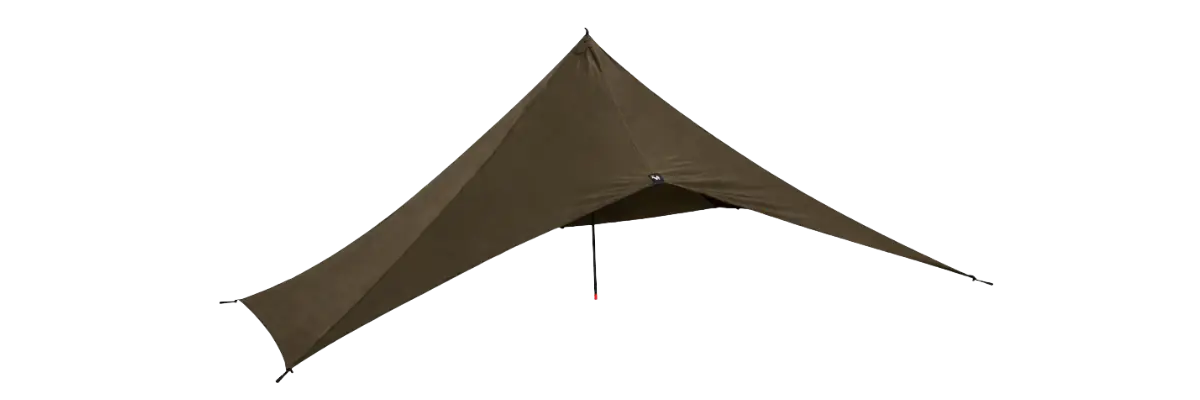
Specs at a Glance: CRICKET PRO
| Spec | MLD Cricket Pro |
|---|---|
| Price (USD) | $205 (20D SilPoly). DCF version comesin at only $385.00. |
| Trail Weight (g and oz) | 0.5 DCF: 150 g / 5.3 oz canopy only with linelocks removed. With 6 linelocks installed: 164 g / 5.8 oz. 20D SilPoly: 257 g / 9.1 oz |
| Packed Weight (g and oz) | Not specified by MLD. Included SilPoly stuff sack (about 0.35 oz) plus 20 ft guyline (about 0.25 oz) bring a realistic packed total near 170 g / 6 oz for DCF |
| Capacity | 1 person |
| Floor Dimensions (length x width) | No integrated floor. Pitched footprint 108 x 51 in / 275 x 130 cm. Optional InnerNet or floor sleeping area is 86 x 30 in / 218 x 76 cm |
| Peak Height (inches and cm) | 50 in / 127 cm, measured at a 5 in off the ground pitch |
| Packed Size | About 0.5 L in SilPoly, roughly 0.6 L in DCF, smaller than a 1 L bottle |
| Shelter Type | Non freestanding single wall asymmetrical pyramid mid with beak, trekking pole supported |
| DCF Canopy Weight (oz/sqyd) | 0.5 oz/sqyd |
| DCF Floor Weight (oz/sqyd) | Not applicable to base shelter. Optional DCF floor and InnerNet use 0.67 oz/sqyd |
| Number of Doors | None. Open beak entry, no zipper |
| Number of Vestibules | 1, the front 25 percent of the footprint acts as a vestibule |
| Wall Construction | Single wall |
| Season Rating | 3 and 3 plus season, mostly below treeline |
| Trekking Poles Required | Yes, 1 pole 125 cm or longer, about 130 cm / 50 in recommended. MLD Camlock pole optional at $45 |
| Warranty | 1 year against manufacturing and material defects |
| Lead Time | Large items 8 to 12 weeks (shelters are large items) |
MLD CRICKET PRO Design and Build Quality
The Cricket Pro shares its bones with the SoloMid Pro, an asymmetrical four sided pyramid with a single center pole. MLD offsets that pole so about 75 percent of the interior sits behind it and the front 25 percent works as a covered entry. The difference is the front: where the SoloMid Pro uses a #3 YKK AquaGuard zipper, the Cricket Pro swaps in a beak, which is the single most important design decision here. No zipper means nothing to jam, ice up, or wear out, and it shaves both weight and cost.
You choose between two fabrics. The 0.5 oz/sqyd DCF canopy comes in light gray with all seams sealed and taped at the factory, so there is no seam sealing chore. The 20D SilPoly version in dark olive green uses triple stitched seams rated past 2,500 mm, but it needs seam sealing, either DIY with the included tube or as a paid factory service.
Hardware is deliberately sparse. You get 6 ground level perimeter tie-outs, lightweight linelocks sized for 1.7 to 2.2 mm line that you can remove to save about 14 g, a reinforced peak, an interior apex hang loop, two overhead hang loops, and four corner clips for an InnerNet. The premium price is not about features. It is about DCF itself, a laminate that does not stretch when wet, does not sag overnight, and packs down to almost nothing, paired with MLD’s long standing reputation for clean, durable construction.
Setup and Pitch of the CRICKET PRO
Here is where you need to read carefully, because the pitched footprint and the usable space are two different numbers. The shelter stakes out to 108 by 51 in (275 by 130 cm), but that is the outer pyramid, not a floor. If you add the optional InnerNet or floor, your actual sleeping rectangle is 86 by 30 in (218 by 76 cm) with 7 in walls.
Peak height is 50 in (127 cm), which is generous for a shelter this light and means most solo users can sit up without brushing the apex. The single offset pole keeps that headroom over the sleeping area rather than wasting it over the door.
Fit is the honest sticking point. MLD’s own guidance is specific: at a 6 in off the ground pitch with a 130 cm pole, you fit if you are under 6 foot 1 on a 3 in pad or thinner. Drop the pitch lower for more weather protection and the height ceiling drops with it. Tall sleepers over 6 foot 1 should look at the SoloMid XL instead. Side sleepers and anyone who rolls around will find the 30 in InnerNet width snug, and InnerNet users right at 6 foot will feel the netting touch the toe of their quilt. This is a solo shelter in the truest sense. There is no realistic two person configuration, and vestibule storage is limited to the front beak area, fine for a pack and shoes, not for sprawling out gear.
Weather Performance of the MLD CRICKET PRO
A four sided pyramid is one of the easiest shelters to pitch, and the Cricket Pro is no exception. MLD claims under 2 minutes after a little practice, and that is believable. You stake the rear two corners, stake the front two corners while keeping the base a true rectangle, then insert a single trekking pole and raise it to tension everything. Four stakes get you pitched, with the other two perimeter tie-outs and any mid-panel guylines added as conditions demand.
The learning curve is real but short, and it lives almost entirely in getting the base square. MLD is blunt that nearly every setup problem comes from a floor that is not rectangular with roughly 90 degree corners, or from slack left in the corner lines. Get the rectangle right and the rest follows.
This is where DCF’s zero stretch behavior matters, and it cuts both ways. A SilNylon tent lets you pull a sloppy pitch tight because the fabric gives. DCF does not give at all, so a lazy stakeout stays baggy. The fix is built into the geometry: because it is a rectangular pyramid, you simply raise the center pole an inch to retension the whole canopy at once, no restaking needed. Use a 130 cm or 50 in pole for the recommended 6 in off the ground pitch, or shorter poles for a lower, more weatherproof setup. No trekking poles? The MLD Camlock pole is a $45 add on. On uneven ground the high off the ground pitch helps you bridge lumps, which is a quiet advantage over floored tents.
MLD CRICKET PRO Value and Comparisons
Pyramids are good in wind for a reason. The low, taut, aerodynamic shape sheds gusts rather than catching them, and DCF’s refusal to stretch means the canopy holds its shape through the night instead of flapping loose. With the perimeter tie-outs staked and the optional mid-panel and apex guylines deployed, this is a stable shelter for its weight class. MLD publishes no specific mph wind rating, and because the Cricket Pro is new for 2026 there is not yet independent storm testing to cite, so treat wind claims as based on geometry and the long track record of MLD mids rather than lab numbers.
Rain shedding is strong. The DCF version arrives fully sealed and taped, and DCF is inherently waterproof with no wetting out. The catch is the beak. Without a zippered door, the front is more open than a fully closeable shelter, so you must orient the beak away from driving rain and wind, and a misjudged setup can let blown spray reach the entry.
Condensation is the unavoidable reality of any single wall shelter, and the Cricket Pro is no exception. You manage it, you do not eliminate it. Pitching a few inches off the ground creates airflow under the perimeter, and the beak opening vents the peak. Lower storm pitches trade that ventilation for protection, so expect more interior moisture when you batten down. The base shelter has no bathtub floor, so ground splash and runoff protection is on you unless you add the InnerNet or floor, which gives 7 in walls.
CRICKET PRO Value and Comparisons
At first glance a sub 6 oz DCF shelter looks like a steal against any full tent. The honest framing is that you are not comparing like with like until you add a floor and bug net, so the comparisons below are about use case, not just raw grams.
MLD SoloMid Pro is the obvious first stop, because it is the same shelter with a zippered #3 YKK door instead of a beak. The SoloMid Pro weighs 6.5 oz in DCF and tops MLD’s range at $455. Choose the SoloMid Pro if you want a real closeable door for bugs, privacy, and driving rain, and the Cricket Pro if you want to save roughly an ounce and some money and you genuinely do not mind a beak.
Zpacks Plex Solo is the turnkey alternative at $599, weighing 13.9 oz in standard trim or 11.8 oz in the Lite version. That weight buys a complete tent: bonded DCF canopy, sewn in bathtub floor, full bug netting, and a vestibule, pitched with a single 52 in pole. Choose the Plex Solo if you want to buy one box and be done, with bug and ground protection built in. The Cricket Pro only approaches that completeness once you add the InnerNet, which costs $235 and 7.5 oz, pushing the real world weight near 13 oz and the price well up, at which point the Plex Solo is the simpler buy.
Durston X-Mid Pro 1 is the livability and storm champion, a fully featured DCF tent with two doors, two vestibules, a bathtub floor, and netting, weighing about 15.5 to 17.8 oz and priced around $650. It needs two trekking poles and fits hikers up to 6 foot 8. Choose the X-Mid Pro 1 if interior room, weather protection, and tall sleeper fit matter most and you accept the weight and two pole requirement.
Who should pick the Cricket Pro? The super ultralight hiker, fastpacker, or racer who counts every gram, camps below treeline in 3 season conditions, has the skills to pick sheltered sites, and either skips bug protection or pairs the canopy with a bivy. For anyone who wants a complete tent out of the box, the Plex Solo or X-Mid Pro 1 is the better value despite weighing more.
CRICKET PRO by Mountain Laurel Designs (MLD) FAQ
Is the MLD Cricket Pro waterproof in heavy rain?
Yes, the DCF version arrives fully seam sealed and the fabric is inherently waterproof, and the SilPoly version is rated past 2,500 mm once seam sealed. The weak point is the open beak, so you need to orient the beak away from the wind and rain and pitch it taut, otherwise blown spray can reach the entry.
Does the Cricket Pro come with a floor or bug net?
No. The base price buys the canopy only, with no floor and no insect protection. You add an InnerNet or a separate floor as a paid option, which adds both weight and cost, so budget for that if you camp in buggy or wet ground conditions.
How hard is the Cricket Pro to set up?
It is one of the easier shelters to pitch once you learn it, often under 2 minutes with practice using one trekking pole and four stakes. The only real skill is keeping the base a true rectangle with square corners, since DCF does not stretch and will not tension out a sloppy stakeout.
Will I fit in the Cricket Pro if I am tall?
If you are under 6 foot 1 on a 3 in pad or thinner you will fit with a 6 in off the ground pitch and a 130 cm pole. Taller hikers, side sleepers, and anyone using the InnerNet near 6 foot should expect a snug fit, and MLD steers people over 6 foot 1 toward the larger SoloMid XL.
Is the Cricket Pro good for thru-hiking?
It can work for an experienced ultralight thru-hiker who camps below treeline and pairs it with a bivy or InnerNet, but the no floor design and thin 0.5 DCF canopy demand careful site selection. Hikers who want maximum durability and bug protection for months on trail are usually better served by a fully floored shelter.
How much does the DCF Cricket Pro weigh?
The 0.5 DCF canopy is 5.3 oz (150 g) with the linelocks removed, or about 5.8 oz (164 g) with all six linelocks installed. The 20D SilPoly version weighs 9.1 oz (257 g).
Cricket Pro or SoloMid Pro, which should I get?
They are the same shelter except the SoloMid Pro has a zippered door and the Cricket Pro has a beak. Pick the Cricket Pro to save weight, money, and a failure prone zipper, and pick the SoloMid Pro if you want a fully closeable door for bugs, privacy, and worse weather.