
Free Zip 3P Quick Take
The Zpacks Free Zip 3P is for the hiker who wants Dyneema weight savings but refuses to give up the go-anywhere freedom of a freestanding tent. Its standout strength is the carbon “double X” pole frame, which lets you pitch on sand, granite slab, snow, or a wooden platform with zero stakes, and which holds its shape in wind better than almost anything else Zpacks makes. The main tradeoff is weight and price. At 34.8 oz and $999, it is roughly 50 percent heavier and a couple hundred dollars more than the trekking pole Triplex it shares a floor size with. You are paying a premium to carry poles so you do not have to rely on the ground.
Pros
- Truly freestanding, pitches anywhere without stakes or trekking poles
- Excellent wind stability for an ultralight shelter thanks to stout Easton Carbon 6.3 poles
- Generous interior for two plus gear, fits three on standard pads
- Field-replaceable zipper sliders and fully taped DCF seams
Cons
- Heavy and expensive compared to non-freestanding DCF tents
- Single-wall design means you manage condensation yourself
- Runs small for its capacity, and vestibules are shallow
- Flatter center roof and larger wind profile than the 2P version
Bottom line: a $999, 34.8 oz, three-person freestanding DCF tent that trades grams for the ability to camp where staked shelters cannot.
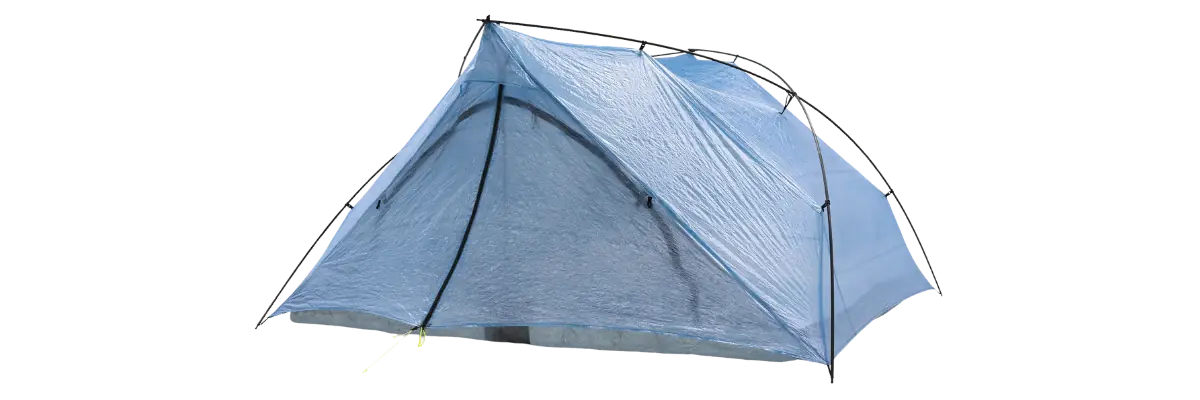
Specs at a Glance: Free Zip 3P
| Spec | Detail |
|---|---|
| Price (USD) | $999 |
| Trail Weight | 987 g / 34.8 oz (Blue or Olive Drab, includes poles, linelocs, taped seams) |
| Packed Weight | About 1018 g / 35.9 oz with stuff sacks, guylines, repair tape, and spare sliders. Spruce Green runs 1060 g |
| Capacity | 3 person |
| Floor Dimensions | 86 in x 60 in (218 cm x 152 cm) |
| Peak Height | 43 in (109 cm) |
| Packed Size | About 6 in diameter x 12 in tall rolled tight, 339 cu in (15.25 cm x 30.5 cm, 5.6 L). Ships in an 8 in x 13 in stuff sack |
| Shelter Type | Freestanding single-wall DCF tent, double X carbon pole frame |
| DCF Canopy Weight | 0.55 oz/sqyd (Blue, Olive Drab) or 0.75 oz/sqyd (Spruce Green) |
| DCF Floor Weight | Not specified |
| Number of Doors | 2 zippered screen doors, one per side, plus 4 storm door panels |
| Number of Vestibules | 2 (one per side, about 13 in deep) |
| Wall Construction | Single-wall DCF canopy, perimeter no-see-um mesh, sewn-in 5 in bathtub floor, dual peak vents |
| Season Rating | 3-season, handles shoulder-season wind well |
| Trekking Poles Required | No, four Easton Carbon 6.3 poles are included |
| Warranty | 2-year limited warranty against defects |
| Lead Time | Ships in 1 to 3 business days |
Zpacks Free Zip 3P Design and Build Quality
The canopy is Dyneema Composite Fabric, 0.55 oz/sqyd in Blue and Olive Drab or a tougher 0.75 oz/sqyd in Spruce Green. DCF is the reason this tent justifies its price. It does not absorb water, does not need a waterproof coating that can wear off, and does not stretch or sag overnight the way silnylon does. The seams are taped rather than stitched and sealed, and Zpacks bonds the tie-outs, so there is no seam sealing chore out of the box.
The structural story here is the four included Easton Carbon 6.3 poles, which arrange into a “double X” on each side and fold down to about 12 inches. Zpacks notes these are thicker and stronger than the Carbon 3.9 poles on the Duplex Flex kit, and that extra stiffness is what gives the Free Zip its wind manners.
Smart touches add up. Every zipper slider can be replaced in the field, and two spares ship in the box along with a strip of DCF repair tape. The bathtub floor is a sewn-in DCF tub that stands 5 inches tall, and mesh pockets sit at each door so you can reach them from inside or out. The hardware is minimal and purposeful. None of it feels like a cottage-shop afterthought.
Setup and Pitch of the Free Zip 3P
The interior floor is 86 inches long by 60 inches wide, the same footprint as the Triplex. That 60-inch width swallows three standard 20-inch pads with almost nothing to spare, which is why it works best as a palace for two. Three average-sized adults fit, but it is a shoulder-to-shoulder fit, not a roomy one.
Peak height is 43 inches, and the domed shape pushes steep walls up at the head and foot, so even tall sleepers should clear the ends without brushing fabric. Two people can sit up side by side and face out opposite doors. The symmetrical layout lets you lie in either direction, which helps when the ground is not perfectly flat.
Storage is the weak spot. The vestibules are only about 13 inches deep on each side, which is fine for boots and a pack apiece but tight if three people each bring a full kit. Mesh pockets near each door, roughly 8 by 6 inches, hold a phone, headlamp, or glasses.
A note that matches what reviewers report: these tents run small for their stated capacity. If you want genuine three-person comfort, treat this as a luxury two-person tent, or size up. Tall hikers and side sleepers will be happiest using it for two.
Weather Performance of the Zpacks Free Zip 3P
This is where the Free Zip earns its name. You insert four pole tips into rings at the corners and peaks, cross the tips at the top, clip the wall to the poles, and it stands on its own. No trekking poles, no tensioning guylines required, no fussing with stake geometry. Most people are pitching it confidently within a few tries, and it sets up the same way every time, which is the real appeal of a freestanding design.
Because it is freestanding, you can pick it up after building it and shuffle it around to find a root-free, level spot, then anchor it. On a calm night you can leave it completely unstaked. In typical weather you will want about six stakes for the corners and storm doors, and a full storm pitch uses up to ten.
DCF does not stretch, and that cuts both ways here. The upside is that once it is taut, it stays taut all night and will not sag when it gets wet. The downside is that DCF gives you no forgiveness, so if a panel pitches with a wrinkle, you fix it by repositioning poles or stakes rather than cranking tension out of the fabric. On uneven or hard ground the pole frame does the work that staking normally would, which is exactly the point. Beginners tend to find it more intuitive than a trekking pole tarp.
Zpacks Free Zip 3P Value and Comparisons
Wind is the Free Zip’s calling card. Zpacks calls the 3P its most capable three-person tent in high wind, crediting the stiff Easton Carbon poles, which resist deflection in a gale, and a body that drops nearly to the ground at the ends to block cold air. Independent reviewers echo that it feels closer to a light-duty four-season tent than a typical ultralight shelter, though specific mph ratings are not published.
Be honest about the 3P’s limits versus the 2P. The larger body presents more sail area and a flatter center roof, so it is a touch less wind-stable than the smaller 2P and has more potential for snow to pool on the top in a heavy storm. Neither is a dealbreaker for three-season use, and a quick bump from inside knocks accumulating snow off.
Rain shedding is excellent because DCF is inherently waterproof, and the overhanging canopy keeps drips out even with doors open. Condensation is the thing you manage yourself, as with any single-wall tent. Two peak vents promote airflow, the perimeter mesh breathes, and the design slopes any interior moisture down and out away from the floor rather than onto your bag. Leave a downwind door cracked unless the weather is genuinely nasty.
Free Zip 3P Value and Comparisons
At $999 this is a niche purchase, so the question is not whether it is expensive, but whether freestanding DCF is worth it to you. Three comparisons frame the decision.
Zpacks Triplex (about $799, roughly 21 to 22 oz, DCF, non-freestanding). Same floor size, same fabric, in-house sibling. The Triplex is around 13 oz lighter and $200 cheaper, but it needs trekking poles and a careful staked pitch. Choose the Triplex if you already hike with poles and camp mostly on stakeable ground. Choose the Free Zip if you frequently face rock, sand, snow, platforms, or want true freestanding convenience and better wind performance.
Big Agnes Copper Spur HV UL3 (about $600 to $650, trail weight near 3 lb 6 oz, double-wall nylon). The mainstream benchmark. It is roughly 19 oz heavier and bulkier, but it is also several hundred dollars cheaper and its double-wall design manages condensation for you, which matters if you camp in wet, still conditions a lot. Choose the Copper Spur if budget and fuss-free condensation control matter more than weight. Choose the Free Zip if shaving a pound and packing smaller is worth the premium and the single-wall tradeoff.
Zpacks Free Zip 2P (lighter, more wind-stable). If three-person capacity is not a hard requirement, the 2P is the better-executed version of this design, with a smaller wind profile and less snow-loading concern. The 3P only makes sense if you genuinely need the width for two people plus a dog, two adults who want to sprawl, or three people on a tight pitch.
Buy the Free Zip 3P if you are a couple or small group who values freestanding versatility, camps in windy or non-stakeable terrain, and is willing to pay top dollar to carry less than a comparable nylon dome.
Free Zip 3P by Zpacks FAQ
Is the Zpacks Free Zip 3P good in rain and wind?
Yes on both. The DCF canopy is naturally waterproof with taped seams, and the body comes down close to the ground at the ends. The stiff Easton Carbon poles make it one of the more wind-stable ultralight tents available, closer to a light four-season tent than most three-season shelters.
Is it hard to set up?
No. It is one of the easier ultralight tents to pitch because it is freestanding. You slot four poles into rings, cross the tips at the peak, clip the walls, and it stands. You can stake it down afterward if weather demands, using six stakes in typical conditions and up to ten in a storm.
Do I need trekking poles or a footprint? Neither. The four carbon poles are included, so you do not need trekking poles. A footprint is not required because the DCF floor is durable and field-repairable, though an optional flat groundsheet is available if you want extra insurance on rough ground.
Does it really sleep three people?
It fits three adults on standard 20-inch pads, but it is a snug fit at 60 inches wide. Most users find it ideal as a spacious two-person tent with room for gear or a dog. If you want true three-person comfort, plan to size up or treat it as a luxury two.
How does it handle condensation?
Like any single-wall tent, it can collect interior condensation in damp, still conditions. Two peak vents, perimeter mesh, and a floor that channels moisture outward all help, and cracking a downwind door makes a big difference. You manage it actively rather than relying on a second wall.
Will tall hikers fit?
The 86-inch floor and steep domed ends give even tall sleepers head and foot clearance without brushing the walls. The bigger constraint for tall or broad hikers is width, so they will be most comfortable using the tent for one or two people rather than three.
Why is it so much heavier than the Triplex?
The weight and most of the cost difference come from the four carbon tent poles, which add roughly 14.6 oz and let the tent stand on its own. That is the price of freestanding convenience and wind stability. If you do not need either, the lighter, cheaper trekking pole Triplex covers the same floor space.