
Duos 2p Quick Take
The Bonfus Duos 2p is a single-wall, trekking-pole DCF tent built for hikers who want a tall, storm-anchorable shelter and care more about headroom and weather security than shaving off every last gram. Its standout strength is livable height, with a peak of 127 to 130 cm (50 to 51 in) that lets you actually sit up, paired with up to 16 guyout points for a planted, low-to-the-ground pitch in exposed terrain. The main tradeoff is weight: at 675 g (23.8 oz) it is noticeably heavier than the Zpacks Duplex Pro and Durston X-Mid Pro 2 it competes against. You are paying a Dyneema price for a tent that leans toward robustness rather than the lightest possible number.
Pros
- Tall 127 to 130 cm peak gives genuine sit-up headroom, rare in this category
- Up to 16 guyout points make it credibly storm-ready for Nordic and alpine camps
- Silpoly floor option is more abrasion resistant and packs smaller than an all-DCF floor
- European-made and often cheaper than the Zpacks flagship
Cons
- Heavier than the Duplex Pro and X-Mid Pro 2 at the same price tier
- Single-wall construction puts condensation management on you
- 115 cm (45 in) floor width is snug for two wide sleeping pads
- Stakes are not included and warranty terms are not published
Bottom line: At $649 to $749, a 675 g (23.8 oz) trail weight, and a true 2-person capacity, the Duos 2p is a tall, storm-ready DCF tent for hikers who value headroom and anchoring over chasing the lowest weight on the shelf.
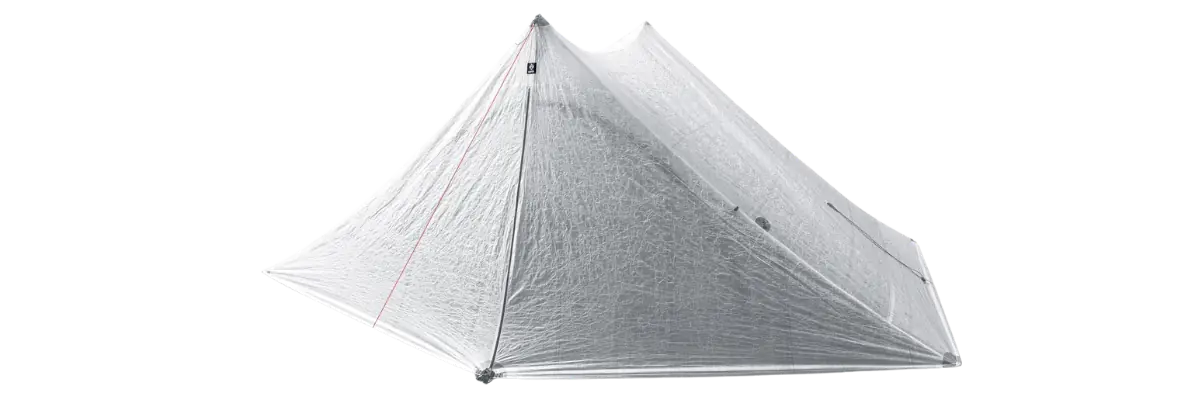
Specs at a Glance: Duos 2p
| Spec | Bonfus Duos 2p |
|---|---|
| Price (USD) | $649 to $749 (varies by fabric and floor) |
| Trail Weight | 675 g / 23.8 oz (tent with pre-mounted guylines) |
| Packed Weight | 688 g / 24.3 oz (tent plus 13 g stuff sack) |
| Capacity | 2 person |
| Floor Dimensions | Not specified (length) x 115 cm (45 in) width. Pitched fly length 280 cm (110 in) |
| Peak Height | 127 to 130 cm (50 to 51 in) |
| Packed Size | 15 x 33 cm (6 x 13 in), diameter x length |
| Shelter Type | Single-wall, trekking-pole, 3-season |
| DCF Canopy Weight | 0.75 oz/sqyd |
| DCF Floor Weight | 0.96 oz/sqyd (DCF floor option). Standard suggested floor is 1.2 oz 20D silpoly |
| Number of Doors | 2 |
| Number of Vestibules | 2 |
| Wall Construction | Single-wall with integrated stitched-in mesh |
| Season Rating | 3-season |
| Trekking Poles Required | Yes, two, set to 127 to 130 cm |
| Warranty | Not specified |
| Lead Time | Not specified |
Bonfus Duos 2p Design and Build Quality
The canopy is 0.75 oz/sqyd Dyneema Composite Fabric, a step up in opacity and durability from the thinner 0.55 oz/sqyd cloth used on lighter shelters, and Bonfus rates the DCF at over 20,000 mm of waterproofness. That heavier canopy is part of why the Duos weighs what it does, and it is a deliberate choice toward longevity over the absolute minimum.
The floor is where Bonfus does something a little different. The suggested option is 1.2 oz 20D silpoly, which gives you better abrasion resistance and a smaller packed size than a comparable DCF floor, with a 0.96 oz/sqyd DCF floor available if you want an all-Dyneema build. Silpoly absorbs almost no water and does not sag the way silnylon does, so the practical downside is minimal.
Construction details hold up to the price. All seams are sewn and then taped on the exterior for both strength and full waterproofing, and every guyout and high-stress point is reinforced with laser-cut Ultra100X. The doors run on two YKK Uretek water-resistant #3 zippers with tension-relief buckles at the base, which take strain off the zipper itself. Guylines use a 2.5 mm UHMWPE core with a polyester sheath, the inner mesh is a fine 15D, and the package includes 30 cm of repair tape, 10 m of extra guyline, and six line locks. It is a handmade Italian tent, and the finish reflects that.
Setup and Pitch of the Duos 2p
This is where the Duos earns its keep. The 127 to 130 cm (50 to 51 in) peak height is tall for a trekking-pole DCF tent, and it translates directly into being able to sit upright, change clothes, and ride out a storm without your head pressing the canopy. Most rivals in this class top out around 48 in, so the extra couple of inches is meaningful when you are stuck inside for hours.
The pitched fly length is 280 cm (110 in), which gives tall sleepers real margin at the head and foot, though Bonfus does not publish the inner floor length, so verify it against your height if you are over six feet.
The honest constraint is width. At 115 cm (45 in) the floor is a genuine two-person space for regular pads, but tight for two wide pads, and reviewers consistently describe it as cozy with two people plus gear. Side sleepers fare fine solo; two side sleepers will be shoulder to shoulder.
Storage is handled by two symmetrical vestibules at 60 to 65 cm (24 to 26 in) deep, enough for packs and boots for each occupant, plus cooking space in poor weather. Inside there is one mesh storage pocket and two hanging points for a headlamp or drying socks. It is a clean, minimalist interior rather than a feature-loaded one.
Weather Performance of the Bonfus Duos 2p
The Duos is a symmetrical two-pole pitch that goes up with a minimum of six stakes: four corners and the two doors. You set both trekking poles to 127 to 130 cm, stake the corners square without over-tightening, raise the poles, then tension the doors and finally the corners. Most people get a clean pitch within a few minutes once they have done it two or three times, but it is not a four-stake-and-walk-away tent, so budget a practice pitch in the backyard first.
The single most important thing to understand is that DCF does not stretch, at all, wet or dry. With a silnylon tent you can yank out a sloppy pitch later as the fabric gives. With the Duos, what you stake is what you get, so accurate, square stake placement is the whole game. Get the corners right and it pitches drum-tight with no wrinkles. Get them wrong and you will be re-staking, because the fabric will not bail you out.
On uneven or sloped ground the symmetrical design is fairly forgiving, and you can raise the poles slightly for more ventilation or drop them for a lower, more storm-resistant profile. For beginners, the learning curve is moderate. It is more involved than a freestanding tent but very manageable, and the no-stretch behavior is the one habit worth internalizing before a real trip.
Bonfus Duos 2p Value and Comparisons
Bonfus designed the Duos for Nordic conditions, and the design choices back that up. The walls come low to the ground to block wind and rain splatter, and the headline feature is the anchoring: up to 16 guyout points, with a set of removable extra points you add when the forecast turns. Worth flagging, the manufacturer’s own copy is inconsistent here, describing six removable points in one place and eight extra points in another, so treat the exact count as approximate. The tent has been field tested above the Arctic Circle and at altitude, per Bonfus, though the company does not publish a tested wind-speed rating, so there is no specific mph figure to cite.
Rain shedding is excellent, as you would expect from taped-seam DCF that does not wet out or absorb water, and it dries almost instantly after a storm.
Condensation is the standard single-wall reality, and you should plan for it. The good news is that field reports describe the Duos as airy for a single-wall tent, helped by adjustable pole height and the door openings. The catch is that in full storm mode, with the walls pulled low to the ground, airflow drops and condensation rises, so you trade ventilation for protection exactly when you most need protection. Pitch away from water, leave the doors cracked when you can, and keep a small cloth handy.
Duos 2p Value and Comparisons
DCF tents are expensive, so the real question is what the Duos does that its closest rivals do not.
Versus the Zpacks Duplex Pro ($799, 553 g / 19.5 oz): The Duplex Pro is the refined, made-in-USA benchmark, with a more intuitive symmetrical pitch, peak vents, magnetic door toggles, and a clearly stated two-year warranty. It is lighter by roughly 120 g and easier to live with day after day. The Duos counters with a taller peak (50 to 51 in versus about 48 in), more aggressive storm anchoring, the silpoly floor option, and a lower price. If you want the lightest, most polished, most supported option, the Duplex Pro wins. If you want more headroom and a more planted storm pitch for less money, the Duos is the better buy.
Versus the Durston X-Mid Pro 2 (about $639 to $679, 509 g / 17.9 oz listed): The X-Mid is the value and simplicity champion, with an offset-pole geometry that pitches with just four stakes, a wider 48 in floor, and a reputation for being the easiest tent in the category to set up well. It is also lighter and roughly the same price. The Duos asks for six stakes and more fiddling, and it weighs more, but it gives you a taller peak and a more enveloping low-to-ground pitch with more tie-out options. Choose the X-Mid for easiest setup, more width, and lowest weight. Choose the Duos for headroom and storm anchoring.
Who should pick the Duos: buyers who want a tall, storm-anchorable DCF tent for exposed or Nordic 3-season conditions, who value a more durable silpoly floor, who are buying within Europe and want to skip US import costs, and who are willing to carry a couple of extra ounces for those gains. Gram-counters, beginners who want the simplest possible pitch, and buyers who prioritize a clearly documented warranty will likely be happier with the X-Mid Pro 2 or Duplex Pro.
Duos 2p by Bonfus FAQ
Is the Bonfus Duos 2p good in heavy rain and wind? Yes. The taped-seam DCF sheds rain extremely well and does not wet out, and the low-to-ground walls plus up to 16 guyout points make it genuinely storm-capable when fully anchored. Bonfus does not publish a tested wind-speed number, so the rating is based on its design and field reports rather than a lab figure.
How hard is the Bonfus Duos 2p to set up? It is a moderate learning curve. You pitch it with two trekking poles and a minimum of six stakes, and because DCF does not stretch, accurate square stake placement matters more than with a nylon tent. Do one or two practice pitches at home and it becomes quick.
Does the Bonfus Duos 2p have condensation problems? Like any single-wall tent, it can collect condensation, especially in still, humid conditions or when pitched low for storms. It ventilates well for its class thanks to adjustable pole height and the door openings, so siting it away from water and cracking the doors when weather allows keeps it manageable.
Can two people really fit in the Bonfus Duos 2p?
Yes, but it is cozy. The 115 cm (45 in) floor comfortably fits two regular pads, while two wide pads will be a tight squeeze. The tall peak and two vestibules help a lot with the sense of space and gear storage.
Is the Bonfus Duos 2p worth it compared to a Zpacks Duplex?
It depends on priorities. The Duos is usually cheaper than the Duplex Pro and gives you more headroom and storm anchoring, while the Duplex Pro is lighter, more refined, and comes with a stated warranty. For Europe-based buyers, the Duos also avoids US import costs.
Do you need a footprint for the Bonfus Duos 2p?
No. The suggested silpoly floor is abrasion resistant and the DCF floor option is durable too, so a footprint is optional rather than required. On sharp or rocky ground a thin groundsheet is cheap insurance, and remember that stakes are not included and must be bought separately.
What length trekking poles do you need for the Bonfus Duos 2p?
You set both poles to 127 to 130 cm (50 to 51 in). Shorter poles will leave the canopy sagging to the ground, and going slightly higher within range increases ventilation. If you do not hike with trekking poles, Bonfus sells carbon tent poles for the Duos.