
CrossPeak 2 Quick Take
The HMG CrossPeak 2 is Hyperlite Mountain Gear’s first freestanding tent, and it is aimed squarely at the hiker who wants a Dyneema shelter that does not depend on trekking poles or a perfect stake-out to stand up. Its standout strength is the combination of a genuinely freestanding pitch with a sub-two-pound carry weight, which is rare air that only a couple of shelters occupy. The main tradeoff is the price, because at $950 you are paying a steep premium over comparable freestanding tents that cost half as much and weigh only a pound more.
You should look hard at this tent if you camp on rock, sand, snow, or wooden platforms where stakes do not bite, and if Dyneema’s no-sag, pitch-in-the-rain behavior matters to you.
Pros
- Fully freestanding inner with a true sub-two-pound weight
- 100% waterproof DCF that does not sag when wet and lets you pitch fly-first in rain
- Steep walls, a 42 inch peak, and a roomy feel for one or a cozy fit for two
- Optional trekking pole reinforcement for serious wind
Cons
- Very expensive at $950
- The fabric pole sleeves are fiddly and can pop pole sections apart during setup and takedown
- Too narrow for two wide sleeping pads side by side
- Single-wall condensation is a permanent companion, as with any DCF tent
Bottom line: a $950, 34 oz (964 g), two-person freestanding DCF shelter for hikers who need a pole-supported pitch and will pay for it.
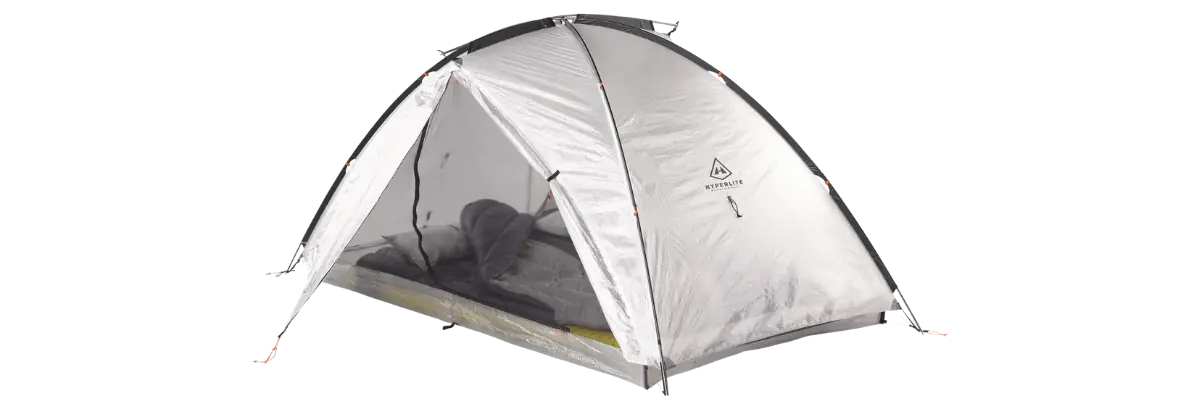
Specs at a Glance: CrossPeak 2
| Spec | Detail |
|---|---|
| Price (USD) | $950 |
| Trail Weight | 34 oz / 964 g |
| Packed Weight | Not specified (HMG publishes 34 oz total, including poles) |
| Capacity | 1 to 2 person |
| Floor Dimensions | 88 in long x 48 in (head) tapering to 45 in (foot) / 223.5 cm x 121.9 cm to 114.3 cm |
| Peak Height | 42 in / 106.7 cm |
| Packed Size | Shelter 10 x 7 x 7 in, poles 14.5 x 2.25 x 2.25 in |
| Shelter Type | Single-wall, freestanding (3-season) |
| DCF Canopy Weight | Approx. 0.55 oz/sqyd (DCF5) |
| DCF Floor Weight | 1.0 oz/sqyd (DCF10) |
| Number of Doors | 2 |
| Number of Vestibules | 2 (7.26 sq ft each, 14.5 sq ft total) |
| Wall Construction | Single-wall DCF canopy with external 20D Sil-nylon pole sleeves, DCF bathtub floor, NoSeeUm mesh |
| Season Rating | 3-season |
| Trekking Poles Required | No (optional peak reinforcement supported) |
| Warranty | HMG Guarantee, covers defects in materials and workmanship |
| Lead Time | Not specified |
| Poles | 3x DAC Featherlite NFL 8.7 mm aluminum |
| Interior Area | 28.4 sq ft |
| Country of Manufacture | Mexico |
HMG CrossPeak 2 Design and Build Quality
HMG built the CrossPeak 2 around the same Dyneema Composite Fabric philosophy that defines the rest of its catalog, and the material choices are where the price starts to make sense. The canopy uses DCF5 at roughly 0.55 oz per square yard, while the floor steps up to DCF10 at 1.0 oz per square yard for better puncture and abrasion resistance. This is deliberate material placement, putting strength where the ground demands it and shaving grams everywhere else.
The structure runs on three DAC Featherlite NFL 8.7 mm aluminum poles, which HMG chose over carbon for durability. Rather than clip the poles to the canopy, the tent threads them through external 20D Sil-nylon sleeves. That arrangement is the source of both the tent’s biggest strength and its most common complaint, which we will get to in setup.
The floor is a floating DCF bathtub that you can hem up at the head and foot with a simple elastic and cord lock, a small touch that helps block wind and splashback. Both side doors zip from the bottom upward so the fabric hangs down and away from dirt when open, and HMG finished the doors with magnetic toggles and peak vents at each end. Two interior mesh pockets handle small essentials. The seams are taped, the hardware is clean, and the whole thing packs into its own DCF stuff sacks. None of this is flashy. It is the quiet, considered build quality you expect at this tier.
Setup and Pitch of the CrossPeak 2
The interior is the CrossPeak 2’s pleasant surprise. The 42 inch peak height and steep, near-vertical walls give it a roomy feel that punches above its weight, with enough headroom to sit up, change clothes, and even pack your bag under cover during a downpour. The 28.4 square feet of floor area is right around the industry average for a two-person ultralight tent.
The footprint measures 88 inches long and tapers from 48 inches at the head to 45 inches at the foot. That length is generous and comfortably handles tall sleepers up to roughly 6 foot 3, and side sleepers will not feel boxed in thanks to those vertical walls. The taper is the catch. You can read it as bonus space added at the head or as space removed at the foot, but the practical consequence is the same: two wide (25 inch) sleeping pads will not fit side by side. Two standard 20 inch pads fit, though shoulders will touch. As a solo shelter, it is a palace.
Storage is handled by two vestibules at 7.26 square feet each, which is a strong 14.5 square feet total and noticeably more than some freestanding rivals offer. Inside, you get two small mesh pockets, one per side. Several reviewers wished for a larger pocket at the foot end, and that is a fair ask on a tent this expensive. For two people plus gear, it is honest two-person space, snug rather than spacious.
Weather Performance of the HMG CrossPeak 2
This is a freestanding tent, so the inner stands up on its own poles with no stakes required to get a structure. That is the entire point, and it shines on tent platforms, granite slabs, sandy desert, and root-choked forest floors where trekking pole shelters struggle. Pitch time is fast once you know the routine, and one person can do it easily. To use the vestibules, you do need to stake them out, which is why some reviewers describe the tent as semi-freestanding rather than fully freestanding.
The learning curve lives in the pole sleeves. The external Sil-nylon sleeves are fiddly, and several testers found the pole sections disconnecting partway through as they fed them, which makes setup and takedown frustrating until you develop a feel for it. It is not difficult so much as annoying, and it is the single most common gripe in field reviews. Plan to stake out the corners and vestibules with around 6 to 10 stakes for a proper, taut pitch.
Here is where Dyneema earns its keep. DCF does not stretch, so once the canopy is taut it stays taut, even soaked through. There is no midnight re-tensioning, no sag after the first rain. For added strength in nasty weather, you can plant trekking poles into the two peaks the way a trekking pole tent uses them, which stiffens the whole structure considerably. Beginners will manage it, but the pole sleeves mean this is not the most idiot-proof tent out there.
HMG CrossPeak 2 Value and Comparisons
For a single-wall DCF shelter, the CrossPeak 2 handles foul weather well. One independent test in Washington’s Central Cascades put it through gusts up to 45 mph on an exposed 6,200 foot ridgeline, and the freestanding pole structure held its shape better than a staked trekking pole tent would in the same wind. Drop trekking poles into the peaks and the storm performance climbs further. Hemming up the bathtub floor sides at the head and foot blocks wind from sneaking underneath, and you can snug the windward side while opening the lee side for airflow.
Rain shedding is excellent because Dyneema is 100% waterproof with no coatings to wear off, and it does not absorb water or sag, which means you can pitch the whole tent fly-first in a downpour without soaking the interior. That is a real advantage over double-wall tents with separate mesh inners.
Condensation is the unavoidable tradeoff of single-wall construction, and you should expect it. Moisture will collect on the inside of the canopy in cool, damp, or humid conditions, and your only defenses are the peak vents, leaving a door cracked, and choosing campsites with airflow. Reviewers consistently note that condensation here is on par with other single-wall DCF tents, no better and no worse, and that the double-wall look does not change the single-wall reality. Field testing across White Mountain rain, Hawaiian humidity, and Pacific Northwest snow and hail confirms it keeps you dry from the outside in, as long as you manage the inside.
CrossPeak 2 Value and Comparisons
At $950, the CrossPeak 2 is a hard sell on price alone, so the question is what you get for the premium and who actually needs it.
The closest rival is the Zpacks Free Zip 2P at around $899 and 31.6 oz. The Free Zip is lighter, uses a carbon double-X pole frame that is exceptionally storm-stable, and is the only other true sub-two-pound freestanding DCF tent on the market. Where the CrossPeak pulls ahead is livability: its 14.5 square feet of vestibule space dwarfs the Free Zip’s roughly 8 square feet, and its boxier interior feels less cramped. If you prize the absolute lightest freestanding pitch and storm stability above all, the Free Zip wins. If you want more usable gear storage and headroom for a similar price, the CrossPeak is the better home.
The Durston X-Dome 2 at $469 and about 44 oz attacks from the value angle. It is roughly ten ounces heavier and is a double-wall polyester tent rather than DCF, but it costs half as much, fits two wide pads across its full 52 inch width, and offers a taller 43 inch peak. Polyester also does not sag and dries fast, narrowing one of DCF’s signature advantages. For most weekend and even thru-hiking use, the X-Dome 2 delivers more tent for far less money.
The Big Agnes Copper Spur HV UL2 remains the mainstream benchmark, with a full double-wall mesh canopy that manages condensation better and costs well under the CrossPeak, at a similar or slightly higher weight.
Choose the CrossPeak 2 if you specifically need a freestanding pitch on surfaces that reject stakes, you want Dyneema’s no-sag and pitch-in-rain behavior, and the weight savings over the X-Dome justify the cost to you. If you can tolerate ten more ounces or a staked pitch, cheaper tents will serve most hikers just as well.
CrossPeak 2 by Hyperlite Mountain Gear (HMG) FAQ
Is the HMG CrossPeak 2 good in heavy rain?
Yes. The DCF canopy is fully waterproof and does not sag when wet, so it sheds rain reliably and lets you pitch fly-first without soaking the inside. It has performed well across rain, wet snow, and hail in field testing.
How does the CrossPeak 2 handle wind?
Well for its weight. One independent test recorded it holding up in gusts to 45 mph on an exposed ridge, and you can boost storm strength further by hemming the bathtub floor and planting trekking poles into the two peaks.
Is the CrossPeak 2 hard to set up?
The freestanding inner pitches quickly, but the external fabric pole sleeves are fiddly and can cause pole sections to pop apart during setup, which frustrates many first-time users. It gets easier with practice, and one person can pitch it alone.
Does the CrossPeak 2 have a condensation problem?
It manages condensation about as well as any single-wall DCF tent, which is to say moisture will collect inside in cool or humid conditions. Use the peak vents, crack a door, and pick a breezy site to keep it down.
Can two people with wide sleeping pads fit in the CrossPeak 2?
No. The floor tapers from 48 inches to 45 inches, which is too narrow for two 25 inch wide pads side by side. Two standard 20 inch pads fit with shoulders touching, and it is genuinely roomy for one person.
Is the CrossPeak 2 a four-season tent?
No. HMG rates it as a 3-season shelter and explicitly states it is not an alpine, mountaineering, or four-season tent. Avoid heavy snow loading and severe winter conditions.
Is the CrossPeak 2 worth $950?
Only if you specifically need a sub-two-pound freestanding pitch and value Dyneema’s no-sag, waterproof behavior. If you can accept a staked pitch or about ten extra ounces, tents like the Durston X-Dome 2 deliver comparable performance for roughly half the price.