
UltaMid 2 Quick Take
The HMG UltaMid 2 is built for the backpacker who wants real four-season protection without hauling a traditional tent. Its standout strength is the combination of a genuinely spacious interior, legitimate storm-worthy geometry, and a trail weight that embarrasses most two-person shelters. The main tradeoff is straightforward: you are paying a premium price for a floorless, single-wall pyramid that demands some setup skill and an honest conversation about condensation.
Pros:
- 63 sq ft of interior floor space puts most two-person tents to shame in terms of livable area
- DCF8 fabric is among the most durable materials used in ultralight shelters, resisting abrasion and UV far better than silnylon competitors
- Pyramid geometry sheds wind from any direction without flexing or bowing the way pole-supported designs can
- Fully seam-sealed from the factory with dual peak vents and robust YKK Aquaguard zippers
Cons:
- Base price of $735 covers only the tarp shell; a usable bug-proof or fully floored setup runs $1,100 or more
- Condensation is a real issue in cold or humid conditions since this is a single-wall design
- Requires two trekking poles lashed together (or HMG’s optional carbon pole), which adds complexity and cost for non-pole-users
- Packed size is bulky relative to lighter pyramid competitors; DCF does not compress like silnylon
Bottom line: $735 base price, 19.1 oz / 541 g trail weight, two-person capacity; one of the most space-efficient ultralight four-season shelters on the market if you can stomach the cost of a complete setup.
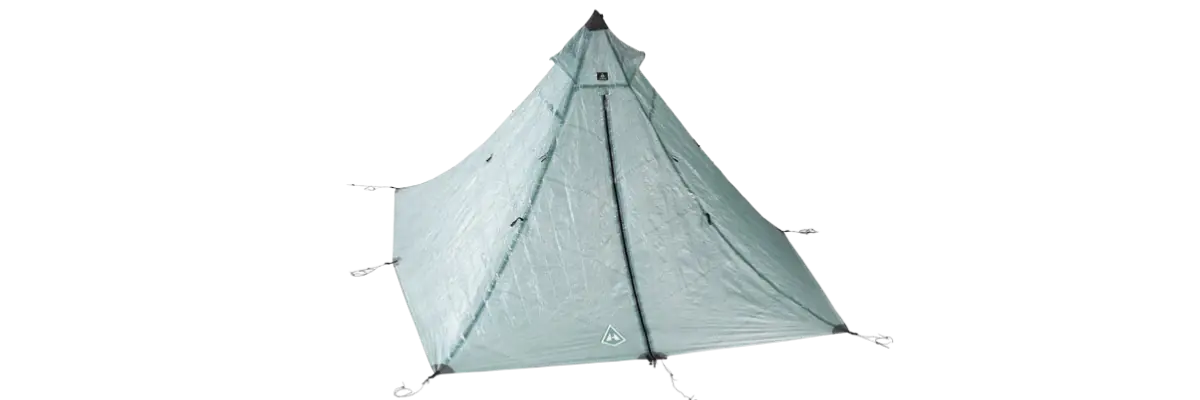
Specs at a Glance: UltaMid 2
| Spec | Value |
|---|---|
| Price (USD) | $735 (tarp only); $1,100+ with full DCF insert |
| Trail Weight | 534 g / 18.85 oz (tarp only, no poles or straps) |
| Packed Weight | Not specified by manufacturer |
| Capacity | 2 persons |
| Floor Dimensions | 107 in x 83 in / 272 cm x 211 cm (63 sq ft / 5.85 sq m) |
| Peak Height | 64 in / 163 cm |
| Packed Size | Approx. 8.5 in x 6 in x 5.5 in (user-reported; can pack smaller) |
| Shelter Type | Single-wall pyramid mid (floorless tarp) |
| DCF Canopy Weight | DCF8 (approx. 0.75 oz/sq yd per Adventure Alan; CleverHiker cites 0.8 oz/sq yd) |
| DCF Floor Weight | DCF11 (1.1 oz/sq yd) for optional insert floor |
| Number of Doors | 2 (both can be opened, though doing so reduces pitch stability) |
| Number of Vestibules | 0 (pyramid design; no vestibule porch) |
| Wall Construction | Single-wall DCF with dual peak vents; fully seam-sealed |
| Season Rating | 4-season |
| Trekking Poles Required | Yes; two poles lashed together (or optional HMG carbon pole, 8.4 oz / 238 g) |
| Warranty | Manufacturer warranty against defects in materials and workmanship |
| Lead Time | 3 to 6 weeks (reported by multiple sources; verify current lead time with HMG directly) |
HMG UltaMid 2 Design and Build Quality
The UltaMid 2 is built around DCF8, a heavier-grade Dyneema Composite Fabric that HMG deliberately chose over the thinner DCF5 used in many gram-counter competitors. That decision adds a few grams but pays off in long-term durability. Multiple reviewers report using original UltaMid shelters from 2015 onward with the body fabric still in excellent condition, though zipper wear is the most commonly cited point of eventual failure.
The seams are factory-taped and fully sealed, which saves you the messy and time-consuming job of seam-sealing that many competing shelters require out of the box. The zippers are YKK Aquaguard, a water-resistant design that holds up to extended use far better than standard #3 coil zippers. The reinforced peak cone accepts trekking poles, paddle shafts, or skis, and HMG beefs up the corner guyout reinforcements to handle real storm loads.
You get eight perimeter guylines at ground level plus four additional center-panel tie-outs for storm mode. The hardware throughout, including line locks and cordage, is sized for use with cold or gloved hands rather than optimized purely for gram savings. This is the core argument for the UltaMid’s premium over cheaper pyramid alternatives: the build is not just lighter, it is more thorough.
Setup and Pitch of the UltaMid 2
Sixty-three square feet of floor space sounds like a marketing number until you actually stand inside. At 64 inches of peak height, most adults can stand nearly upright at the center, which is genuinely unusual for an ultralight two-person shelter. For context, that is more floor area than many three-person conventional tents and roughly triple the volume of an average two-person bivy-style setup.
Two sleepers fit comfortably side by side with gear staged along the walls. The center pole does bisect the space somewhat, and you need to plan around it when positioning sleeping pads, but the overall footprint is large enough that it rarely feels cramped. Tall sleepers should note that the sloping walls mean your feet or shoulders may brush the single-wall fabric, which matters for condensation management. In practice, anyone under about 6 feet can sleep diagonally and avoid contact with the walls altogether.
There are no vestibules. This is the sharpest livability limitation of the pyramid design. Wet gear, muddy boots, and cooking come in with you or stay in the rain. Some users pitch the door partially open to create a small covered porch area, but this exposes the interior to wind-driven rain and reduces storm performance. If vestibule storage is non-negotiable for your style of travel, the UltaMid 2 will frustrate you. If you have always managed without one, the sheer floor space compensates generously.
Interior pockets are not a feature of the base tarp. The optional inserts add some organizational options, but the tarp itself is bare fabric.
Weather Performance of the HMG UltaMid 2
The concept is simple: stake the four corners, lash two trekking poles together at the peak, and tension the guylines. In good conditions with flat ground and a few sessions of practice, most people get the UltaMid 2 pitched in under ten minutes.
The learning curve is real on the first few attempts. Getting a taut, wrinkle-free pitch requires you to understand the order of operations: stake the corners first, set the pole height second, then work outward through the perimeter guylines. Skipping steps or tensioning in the wrong order leads to a sloppy pitch that performs poorly in wind. Trailspace testers reported getting it down in under ten minutes after the first outing or two.
The pole height requirement is the biggest practical hurdle. Most trekking poles top out around 130 cm, and the UltaMid 2 needs two lashed end-to-end to hit the 64-inch peak. HMG sells a proprietary pole-joining strap for $15 that simplifies this, and they offer a standalone carbon fiber pole for those who do not carry trekking poles. Non-pole hikers should budget the extra weight and cost of that carbon option.
DCF does not stretch or sag when it gets wet, which is one of its strongest practical advantages over silnylon. Your pitch stays taut through rain and temperature swings without constant re-adjustment. On uneven ground the pyramid’s four-point stake system is more forgiving than dual-pole designs, though rocky or hardpan sites that resist staking will test your patience. A minimum of five stakes is workable; eight to twelve is ideal for storm conditions.
HMG UltaMid 2 Value and Comparisons
Wind resistance is where the UltaMid 2 earns its four-season designation without argument. The pyramid’s geometry deflects wind upward and over the shelter from any direction, with no flat panels to catch a gust. One Pacific Northwest tester returned from a trip that saw 50+ mph gusts and reported the shelter held without issue when staked and guyed correctly. GearJunkie noted similar confidence after use in Mexico, Utah, and Colorado across variable conditions.
Rain shedding is excellent. The fully taped seams and water-resistant zippers do their job, and the steep angle of the walls sheds precipitation quickly. You can also pitch it lower to the ground in storm mode, reducing the gap at the base and limiting wind-driven rain intrusion significantly.
Condensation is the honest weakness. This is a single-wall shelter with no separate inner wall, so your breath and body heat have nowhere to go except onto the fabric. The two peak vents help when there is airflow, and experienced users report that keeping a small gap at the base improves ventilation dramatically. In cold, still, humid conditions, plan to wake up with some moisture on the inner walls. DCF dries fast, which softens this problem on the trail, but it does not eliminate it. If you use the full mesh insert, the dead air space between you and the outer wall reduces direct contact but does not create the condensation-free environment of a true double-wall tent. The severity of condensation is highly dependent on temperature differential and campsite airflow, so your experience will vary.
There is also no vestibule to use as a gear buffer zone when entering and exiting in rain, which means every door opening exposes the interior briefly to the elements.
UltaMid 2 Value and Comparisons
The UltaMid 2 tarp at $735 is expensive relative to what you are physically receiving. The full setup with a mesh or solid DCF insert crosses $1,100 before taxes, shipping, or accessories. That number demands honest comparison.
The Mountain Laurel Designs DuoMid XL in Dyneema runs around $365 and offers a similar pyramid footprint with an offset-forward pole design that frees up slightly more usable rear space. MLD’s build is lighter by a meaningful margin in its silnylon version, and the Dyneema version competes directly with the UltaMid on material quality. Where the UltaMid pulls ahead is in build robustness: heavier-gauge DCF, superior hardware sizing, factory seam sealing, and a track record of decade-plus durability. If you are budget-constrained and willing to do your own seam sealing, the DuoMid XL is the obvious alternative. If you want a shelter you will never have to worry about, the HMG build justifies the premium.
The Zpacks Duplex comes in under one kilogram for the complete setup and delivers two doors and two vestibules, solving the UltaMid’s biggest livability complaint. It uses a lighter-grade DCF and a dual-pole design that is versatile but more complex to tension in serious wind. The Duplex is a better three-season shelter for hikers who prioritize weight and vestibule convenience; the UltaMid 2 is the better choice when storms are a realistic scenario and durability over years of heavy use matters more than shaving another 200 grams.
The Durston X-Mid 2 Pro in DCF offers two vestibules, two doors, and freestanding geometry at a lower price point. Multiple forum users describe it as meaningfully lighter than the UltaMid 2 with insert and easier to pitch for newcomers. It is not the storm machine the UltaMid is, but for three-season thru-hiking in moderate climates it is a serious competitor and better value for most people.
Choose the UltaMid 2 if you are a two-person team doing shoulder-season or winter mountaineering, expect sustained wind and precipitation, and want a shelter that will still be going strong a decade from now. Choose something else if budget is a real concern, if vestibule space matters, or if your trips are primarily three-season in temperate conditions.
UltaMid 2 by Hyperlite Mountain Gear (HMG) FAQ
Does the UltaMid 2 handle heavy rain well?
Yes, reliably. The factory seam sealing, water-resistant YKK Aquaguard zippers, and steep pyramid walls all shed rain effectively. Pitch it snug to the ground in storm mode and it will keep you dry through sustained downpours. The only caveat is that every time you open the door in heavy rain, the interior is briefly exposed since there is no vestibule acting as a buffer zone.
How difficult is the setup?
Moderate. The concept is simple but the execution requires practice. Your first pitch will probably take 15 to 20 minutes and will not be perfectly taut. After a few sessions you will be under ten minutes consistently. The trickiest part is getting two trekking poles lashed securely at the right combined height, so HMG’s pole straps or their optional carbon pole are worth having.
Can I use it in winter or snow?
HMG rates it as four-season and the geometry supports that claim. The pyramid sheds snow load efficiently and the DCF8 fabric handles UV and cold without degradation. You will need to manage condensation more aggressively in cold conditions and make sure you have enough stakes to anchor it in hard-frozen or snowy ground. Many alpine users also dig a small snow trench around the base to improve storm sealing.
Is condensation a serious problem?
It depends on your conditions. In mild weather with good airflow the dual peak vents and a small base gap keep moisture manageable. In cold, still, high-humidity conditions, single-wall condensation is a real thing you will feel. The mesh insert adds a layer of separation that helps, but this is not a double-wall tent and should not be evaluated as one. DCF dries quickly, which limits how much condensation disrupts your morning, but it does not prevent it.
Do I need to buy the insert to use this shelter?
No. The tarp alone is a fully functional floorless shelter, and many thru-hikers use it exactly that way with a separate groundsheet. Without the insert you get more ventilation, less weight, and a lower system cost. The trade-off is no bug protection and no enclosed floor. The insert is worth the investment if you camp in bug-heavy terrain or want a fully sealed sleeping environment.
Will it fit two tall sleepers?
Two people of average height fit comfortably. Sleepers over 6 feet should pay attention to foot placement: the pyramid walls slope aggressively toward the corners, and tall sleepers risk having their feet or sleeping bag pressed against the fabric, which accelerates condensation transfer. Sleeping diagonally or slightly offset from the center pole largely solves this.
How long is the lead time?
Multiple sources report a 3 to 6 week lead time from HMG. Verify current production timelines directly on the HMG website before ordering, particularly if you have a trip deadline.