
Mid 1 Quick Take
The HMG Mid 1 is a 16 oz single-wall DCF pyramid built for solo backpackers who want serious weather protection at a thru-hiker-friendly weight. Its standout strength is the thoughtful pyramid geometry, which gives you a genuinely tall center peak (54 inches), a useful asymmetric vestibule, and rock-solid wind performance from a one-pole pitch. The main tradeoff is interior shape. Like every pyramid, walls slope away from center, so your sit-up bubble is smaller than the floor footprint suggests.
Pros
- Excellent wind stability from steep, taut pyramid walls
- Adjustable bathtub floor lets you tune airflow vs splash protection
- Genuinely fast one-pole setup with included pole jack for shorter trekking poles
- High-quality hardware: YKK Aquaguard zippers, magnetic door keepers, reinforced tie-outs
Cons
- Expensive at $675, even by DCF standards
- Sloping side walls reduce usable headroom away from center
- Heavier than the lightest DCF competitors (Zpacks Plex Solo Lite is under 12 oz)
- Bulky packed size for very small fastpacking setups
Bottom line: $675, 16 oz / 454 g, 1-person three-season shelter.
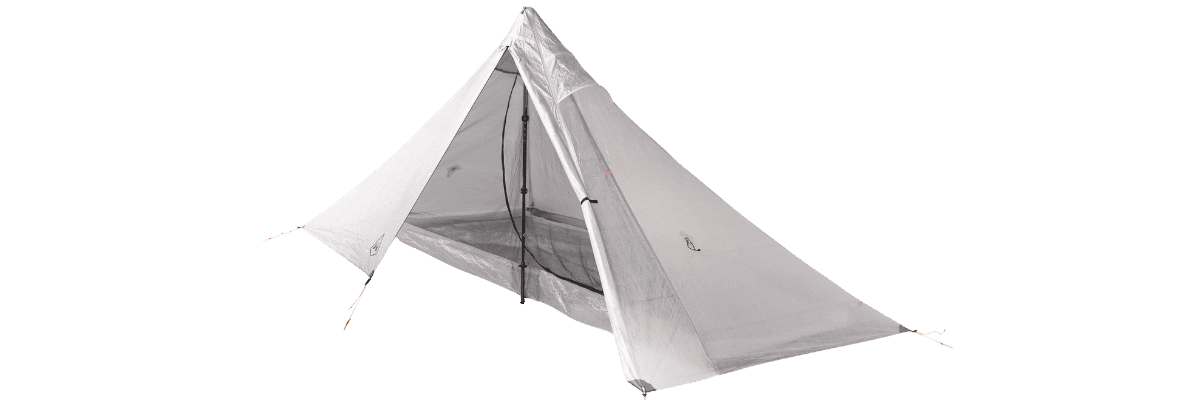
Specs at a Glance: Mid 1
| Spec | Value |
|---|---|
| Price (USD) | $675 (White), $695 (Spruce Green) |
| Trail Weight | 454 g / 16.0 oz |
| Packed Weight | Not specified by HMG (third-party measured ~16.8 oz with stuff sack) |
| Capacity | 1 person |
| Floor Dimensions | 96 x 32 in / 243.8 x 81.3 cm |
| Exterior Footprint | 107 x 54 in / 271.8 x 137.2 cm |
| Floor Area | 21 sq ft |
| Peak Height | 54 in / 137.2 cm |
| Packed Size | 8.5 x 5.5 x 5.5 in / 21.6 x 14.0 x 14.0 cm |
| Shelter Type | Single-wall trekking pole pyramid |
| DCF Canopy Weight | 0.55 oz/sqyd |
| DCF Floor Weight | 0.96 oz/sqyd |
| Number of Doors | 1 (internal mesh + external vestibule) |
| Number of Vestibules | 1 |
| Wall Construction | Single-wall, seam-taped DCF |
| Season Rating | 3-season |
| Trekking Poles Required | 1 pole at 135 cm ± 5 cm (6″ pole jack included for shorter poles) |
| Warranty | Lifetime against manufacturing defects |
| Lead Time | In stock as of publication |
| Country of Origin | Mexico |
| Tie-Out Points | 6 perimeter + 2 rear mid-panel + 2 side mid-panel + 1 apex (11 total) |
| Zippers | #3 YKK (internal), #3 YKK Aquaguard (vestibule) |
| Ventilation | Dual peak vents |
HMG Mid 1 Design and Build Quality
This is where HMG earns its premium price. The Mid 1 uses a 0.55 oz/sqyd DCF canopy (the lightest practical DCF for a fully enclosed shelter) paired with a heavier 0.96 oz/sqyd DCF bathtub floor that resists abrasion from gritty ground better than the canopy fabric would. The apex, where the pole crowns the tent and stress concentrates, is reinforced with DCH50, a hybrid Dyneema with woven face fabric designed for high tensile loads. The perimeter tie-outs use DCF 1.3 reinforcement patches at each linelock, which is the right place to spend grams.
Seams are taped rather than stitched-and-sealed. DCF doesn’t sew well (needle holes leak), so quality DCF tents rely on bonded seams, and HMG’s execution here is clean.
Hardware choices matter on a $675 tent, and HMG didn’t cheap out. You get YKK #3 Aquaguard zippers on the vestibule (water-resistant coating, no flap needed), standard YKK #3 on the internal mesh door, magnetic door keepers that hold rolled-back doors without fiddling, and dyneema linelocks with reflective guylines.
One unique design touch is the included 6-inch pole jack, a tiny 0.6 oz extender that lets shorter trekking poles (or hikers using short poles) reach the required 135 cm pitch height. Most pyramids force you to buy your way to the right pole length. HMG ships the solution in the box.
Setup and Pitch of the Mid 1
The floor measures 96 inches long by 32 inches wide, which is genuinely generous for a one-person shelter. Eight feet of length means hikers up to about 6’4″ can stretch out without their bag touching either wall, and 32 inches of width comfortably fits a 25-inch wide pad with a few inches to spare for clothes or a small dry bag.
Peak height is 54 inches, but here’s the honest version: that’s the literal apex measurement directly over the pole. The pyramid geometry means your actual usable sit-up height (where the walls aren’t pushing into your shoulders) is closer to 48 inches, depending on how broad you are. Adventure Alan’s review made the same observation, calling out low ceiling at the exterior side wall head end and foot end. If you’re a side sleeper hugging one wall, you’ll feel the slope at your face.
The vestibule is one of the Mid 1’s standout features. Because the pyramid is asymmetric, the vestibule footprint is large enough to fit a 55L pack, boots, and a sit pad with room to cook in a pinch. Multiple Trek and Big Outside reviewers specifically called this out as best-in-class.
You get one mesh pocket inside, which feels stingy for the price. Pyramid geometry doesn’t lend itself to many pocket locations, but more buyers would appreciate two or three small organizational pockets.
The adjustable bathtub floor (multiple shock cord points along the rear) lets you raise the walls for splash protection in storms or lower them for better airflow on calm humid nights. It’s a small feature with outsized practical value.
Weather Performance of the HMG Mid 1
The Mid 1 is genuinely one of the faster trekking pole tents to pitch. Stake the four corners, raise the pole to 135 cm, then tension the six perimeter linelocks. Real-world setup runs three to five minutes once you’ve done it a few times. One verified owner reported a five-minute pitch in the dark on his first night.
Stake count: you need six minimum (four corners plus two for the vestibule), and you’ll want 8 to 10 for a fully storm-ready pitch using the mid-panel tie-outs and apex guy. HMG doesn’t include stakes, which is standard for the category but stings on a tent at this price.
DCF’s defining trait is zero stretch. Pitch it tight at sunset and it stays tight all night, even in rain, even with temperature swings. Silnylon tents notoriously sag and require midnight re-tensioning. DCF does not. This is the real reason serious thru-hikers pay the premium.
The flip side: DCF is less forgiving on uneven ground. Because the fabric doesn’t give, a poor stake placement on a slope or a bumpy site shows up as a wonky pitch rather than absorbing the irregularity. Beginners will fight the tent until they learn to scout flatter sites.
For shorter hikers (using 110-125 cm poles), the included pole jack adds the missing height. This is more thoughtful than competitor solutions that just tell you to buy a longer pole.
Beginner friendliness: medium. Easier than a flat tarp, harder than a freestanding dome. Plan to pitch it twice in your backyard before the first trip.
HMG Mid 1 Value and Comparisons
This is where the Mid 1 shines. Pyramid geometry is one of the most aerodynamically stable shelter shapes ever designed, and HMG’s execution delivers.
Wind performance is the headline. Michael Lanza at The Big Outside tested the Mid 1 against 40 mph gusts in Wyoming’s Wind River Range and reported the tent stood firm. Adventure Alan’s review lists sturdy in wind as a primary pro. The 11 total tie-out points (6 perimeter, 4 mid-panel, 1 apex) let you guy out aggressively for serious weather, and the steep wall angles shed gusts rather than catching them broadside.
Rain performance is excellent. Lanza tested the tent in a Wind River thunderstorm where a small stream actually formed under one end of the tent, and both occupants stayed dry inside. The 100% waterproof DCF canopy doesn’t wet out, doesn’t sag, and doesn’t need a fly sheet. The 6-inch bathtub floor handles splashback and shallow runoff.
Condensation is the honest weakness, as with any single-wall shelter. DCF doesn’t breathe. In humid conditions or cold-clear nights, you will get moisture on the inside walls. The dual peak vents help, and Lanza reported only slight condensation after a 40°F dead-calm night in the Winds, which is genuinely good for a single-wall tent. But manage your expectations: in a foggy valley or by a lake, you’ll wake up to damp walls regardless of how you pitch it.
The adjustable bathtub floor is the best condensation tool you have. Lower it on calm humid nights to maximize air circulation under the canopy.
Snow load: skip it. This is a three-season shelter. The walls are steep enough to shed light snow, but the fabric and pole arrangement aren’t built for accumulated snow load.
Mid 1 Value and Comparisons
At $675, the Mid 1 sits squarely in premium DCF territory. Three direct competitors are worth weighing.
Zpacks Plex Solo ($599, 13.9 oz): Lighter and cheaper, with a slightly taller 52-inch peak and a hybrid pyramid shape with overlapping storm doors. The Plex Solo wins on weight by 2+ ounces and saves you $75. Where the Mid 1 wins is build refinement: better hardware, magnetic door keepers, the included pole jack, a more usable vestibule, and (per multiple reviewers) better wind performance under sustained gusts. If you’re an ounce-counter prioritizing the lowest possible scale weight, the Plex Solo is the call. If you want the most refined DCF pyramid experience and plan to use it in real weather, the Mid 1 earns its premium.
Durston X-Mid Pro 1 (~$649, 15.5-17.8 oz depending on floor): A different design philosophy entirely. The X-Mid uses two trekking poles and an asymmetric rectangular fly to create dramatically more usable interior volume, with near-vertical walls that don’t slope into your sleeping space. Reviewers consistently call it the most livable one-person DCF shelter. The tradeoff: it has a larger ground footprint (a problem in tight stealth sites or above treeline), requires two poles, and has a steeper learning curve to pitch taut. If you carry two poles and prioritize livability, the X-Mid Pro 1 is probably the better tent. If you carry one pole or want a smaller footprint for alpine sites, the Mid 1 wins.
Gossamer Gear The One (~$320, 17.7 oz): Half the price, comparable weight, but built from silnylon rather than DCF. You get a non-stretch experience only when dry. In sustained rain, silnylon sags and needs re-tensioning. If $675 makes you wince and you do mostly fair-weather backpacking, The One is a solid compromise.
Who should buy the Mid 1? Solo thru-hikers and weekend backpackers who use a single trekking pole, camp in genuinely variable weather (alpine, Sierra storms, Scottish Highlands), value a small footprint for stealth or rocky sites, and want the most refined DCF pyramid on the market without going full ultralight gram-count chase.
Mid 1 by Hyperlite Mountain Gear (HMG) FAQ
How does the HMG Mid 1 hold up in heavy rain and wind?
Very well. The 100% waterproof DCF canopy doesn’t wet out, the bonded seams don’t leak, and pyramid geometry sheds wind aggressively. Tested reports include 40 mph gusts in Wyoming and Scottish Highland storms without failure. Use all 11 tie-out points for serious weather.
Is the Mid 1 hard to set up for beginners?
It’s medium difficulty. Faster than a flat tarp, slower than a freestanding dome. Plan to pitch it in your yard a few times first. Once you’ve got the technique, three to five minutes is realistic. The trickiest part is learning to scout truly flat ground, since DCF doesn’t stretch to forgive uneven stake placement.
Can I use the HMG Mid 1 in winter or shoulder season snow?
No. It’s a three-season shelter. The walls shed light dustings but the design isn’t built for accumulated snow load. Stick to spring through fall, and treat heavy wet snow as a reason to find a different camp.
How tall a person fits inside the HMG Mid 1?
The 96-inch floor accommodates hikers up to roughly 6’4″ lying flat. The 54-inch peak is over the pole only, with usable sit-up height closer to 48 inches. Tall side sleepers will feel the wall slope at the head and foot of the tent.
Does the HMG Mid 1 have bad condensation?
No worse than any other single-wall DCF shelter, and better than some thanks to the dual peak vents and adjustable bathtub floor. In humid or calm cold conditions, expect some interior moisture. Manage it by venting the bathtub floor and pitching in airflow-friendly sites.
Why is the HMG Mid 1 so expensive?
DCF fabric itself costs roughly 10x more per square yard than silnylon, and bonded-seam construction is labor-intensive. You’re also paying for premium hardware (YKK Aquaguard zippers, magnetic keepers, reinforced tie-outs) and the included pole jack. For thru-hikers logging hundreds of nights, the durability and zero-sag performance justify the price. For occasional weekend trips, cheaper silnylon alternatives may make more financial sense.
Do I need a footprint with the Mid 1?
Not strictly. The 0.96 oz/sqyd DCF floor is fairly abrasion-resistant. But if you camp regularly on sharp rock, scree, or sandy desert sites, a thin polycro footprint adds a few grams and significantly extends floor lifespan. It’s cheap insurance on a $675 shelter.