
The DCF Whisper Quick Take
The Gossamer Gear DCF Whisper is a 9.8 oz floorless single-wall shelter built for one type of hiker: the ultralight obsessive who already owns trekking poles, already carries a polycryo ground sheet, and wants the lightest livable bug-protected DCF shelter on the market that isn’t a bare tarp. Its standout strength is interior volume per gram. The main tradeoff is that you’re buying a $499 minimalist tent that asks you to bring your own floor, accept some learning curve on pitch, and pick your weather windows.
Pros
- Sub-10 oz canopy with full perimeter bug netting
- Tall 130 cm peak with two trekking poles, very livable for taller hikers
- Bio-based DCF, taped seams, waterproof zipper
- Pitch height is adjustable for storm mode without distorting geometry
Cons
- Floorless design requires you to buy and pack a separate ground cloth
- $499 with limited availability and no discounts
- Fixed corner tie-out cords with no built-in length adjustment
- Not eligible for sales or promotions
Bottom line: $499, 9.8 oz / 277.8 g, 1-person. Buy it if you’re chasing a sub-1 lb shelter system and you’re already comfortable pitching trekking pole tarps.
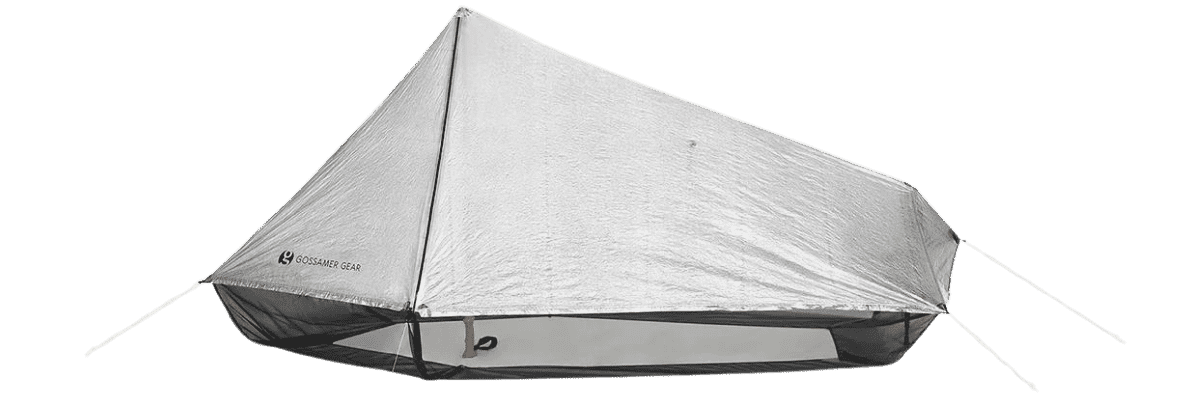
Specs at a Glance: The DCF Whisper
| Spec | Value |
|---|---|
| Price (USD) | $499 |
| Trail Weight | 277.8 g / 9.8 oz (shelter only) |
| Packed Weight | 283.8 g / 10.0 oz (shelter plus 0.2 oz stuff sack) |
| Capacity | 1 person |
| Floor Dimensions | 102 in long, 49 in head width, 25 in foot width (259 cm x 124 cm x 64 cm) |
| Peak Height | 51.4 in / 130.5 cm at pole 1; 23.2 in / 59 cm at pole 2 |
| Packed Size | 5 in x 13 in |
| Shelter Type | Floorless, single-wall, side-entry, trekking pole pyramid with perimeter mesh skirt |
| DCF Canopy Weight | 0.51 oz/sqyd bio-based DCF |
| DCF Floor Weight | Not applicable (no floor) |
| Number of Doors | 1 |
| Number of Vestibules | 1 |
| Wall Construction | Single-wall DCF canopy, sewn and taped ridgeline, 15D nylon no-see-um mesh skirt |
| Season Rating | 3-season |
| Trekking Poles Required | Yes, 2 poles. One set to 130 cm, one collapsed to roughly 23 in (or a 60 cm stick) |
| Warranty | Gossamer Gear standard warranty, defects in materials and workmanship |
| Lead Time | Not specified, sold in limited runs and frequently out of stock |
Gossamer Gear The DCF Whisper Design and Build Quality
The Whisper is the production version of Glen Van Peski’s personal shelter, the Wedge, redesigned for storm and bug performance. That origin story matters because almost every detail is the result of one ultralight obsessive solving his own problems on a bikepacking route, not a marketing brief.
The canopy is 0.51 oz/sqyd bio-based DCF, lighter than the 0.55 to 0.75 oz DCF most competitors use. Gossamer Gear made up for the thinner fabric by adding catenary-cut panels, reinforcing the apex, and using a heavier zipper than the original prototype. The first sample came in at 9.8 oz, and that’s what shipped. The seams are sewn and then taped, with the ridgeline reinforced on both faces for strength.
The perimeter bug skirt is 15D nylon no-see-um mesh without flame retardant treatment, which keeps weight down but means open flames near the tent are a bad idea. Guylines are 1.5 mm reflective Dyneema, with cord locks at the main tensioning points. The zipper is a waterproof YKK style and is one of the genuine durability concerns long-term, since on a floorless shelter the door tends to drag in dirt.
One legitimate gripe from owners: the corner tie-outs are fixed length, not adjustable. If you camp where the ground is rocky and you can’t put a stake exactly where the cord wants it, you’ll be tying truckers hitches or adding your own LineLocs.
Setup and Pitch of the The DCF Whisper
This is where the Whisper genuinely earns its price. At 102 inches long and 49 inches wide at the head, the floor footprint is larger than almost any sub-10 oz shelter on the market. The two-pole, offset geometry is the key, you get a 130.5 cm peak at the head and a secondary 59 cm pole at the foot, so the canopy doesn’t collapse onto your toes the way it does in single-pole pyramids.
Tall hikers, this is built for you. Backpacking Light’s Ryan Jordan, at six feet, has slept in it without his bag touching the canopy at either end. The tapered foot end means side sleepers with their knees up are fine, but if you sleep with your arms spread wide, you’ll feel the walls.
Headroom for sitting is solid near the front pole, plenty of room to change clothes, eat dinner, or wait out a storm without slouching. Toward the foot end, the canopy drops fast and you’re effectively lying down.
The vestibule is raised slightly off the ground, which Gossamer Gear positions as a way to maintain visual contact with your surroundings. Practically, it gives you storage for a pack and shoes while letting air circulate. There are no interior pockets, no door tiebacks beyond a basic loop, and no gear loft. This is a one-person shelter, full stop. It will not fit two adults in any meaningful way.
Weather Performance of the Gossamer Gear The DCF Whisper
The Whisper is not hard to pitch, but it has a specific sequence and you need to read Glen’s instructions before your first attempt. The Outdoor Life tester had it up in under 10 minutes on his first try after reading the FAQ on the product page, and faster after that.
You need 7 stakes. The corner stakes can be lightweight Y-stakes, but the three main tension points (stakes 3, 4, and 5 in Glen’s numbering) want beefier stakes because they take the structural load. Two beefier MSR Groundhogs or similar are the move.
Trekking pole setup: one pole at 130 cm for the front apex, one collapsed to about 23 inches for the rear. If you carry fixed-length poles or only one pole, you can substitute a smooth 60 cm stick for the rear, just don’t use a knotty branch that will puncture the DCF. The front pole goes inside the shelter with the tip into the grommet at the peak.
DCF’s no-stretch behavior works in your favor here. Unlike silnylon, you don’t need to come back at 2 AM to retension. Once you have a taut pitch, it stays taut through temperature swings and overnight dew. The flip side is that DCF doesn’t forgive a bad pitch. If your stakes are placed wrong by a few inches, you can’t tension your way out of it. You have to reset.
On uneven ground, the design tolerates pitch height adjustments well, you can lower the main pole to 120 cm for wind protection without ruining the geometry.
Gossamer Gear The DCF Whisper Value and Comparisons
For a sub-10 oz shelter, the Whisper handles weather better than its weight suggests. Backpacking Light tested it through 15 nights in winds gusting to about 30 mph, overnight lows down to 18°F, light snow loading of about 1.5 inches, and heavy thunderstorms. The shelter held.
For wind, the design philosophy is to pitch the rear toward the prevailing wind, since the rear has less ground clearance and presents a lower profile. In genuinely nasty conditions you can drop the main pole to 120 cm and stake the rear corners directly to the ground for a lower storm pitch, sacrificing interior volume for stability.
Rain shedding is what DCF does best. The fabric is essentially waterproof from day one, the taped seams don’t need additional sealing, and the catenary-cut panels prevent pooling. The waterproof zipper has held up in heavy rain in reviewer testing.
Condensation is the honest weakness, as it is with every single-wall shelter. The Whisper helps itself with a large mesh perimeter that acts as continuous ventilation, so in moving air it performs well. In dead-calm, high-humidity conditions near water, you will get interior moisture. The full perimeter mesh skirt means you can’t fully seal it up to trap warmth, which is good for condensation and less good if you wanted a 4-season shelter (you don’t, this isn’t one).
The “bathtub floor” doesn’t exist, because there’s no floor. Your polycryo or DCF ground sheet sits on top of the mesh skirt, so water running down the canopy hits the mesh and drains outside your sleeping zone. It works, but in driving rain with a gust hitting the door side, you can get spray reaching the edges of your ground cloth. Site selection matters more here than with a fully enclosed tent.
The DCF Whisper Value and Comparisons
At $499 for a shelter without a floor, the Whisper invites comparison.
Zpacks Plex Solo Lite ($599, 11.8 oz): The Plex Solo Lite is the obvious cross-shop. You pay $100 more and add 2 oz, but you get a sewn-in bathtub floor, a 52-inch peak height, and a more conventional fully enclosed tent feel. The Plex pitches with a single pole, which some hikers prefer. Choose the Plex Solo Lite if you want a true tent experience, don’t want to fuss with a ground cloth, and value Zpacks’ broader support and availability. Choose the Whisper if every gram matters and you don’t mind the floorless workflow.
Zpacks Hexamid Pocket Tarp with Doors (around $349, sub-6 oz): Lighter and cheaper, but smaller, less storm-worthy, and lacks the integrated bug skirt. The Whisper is significantly more livable and weather-capable. Choose the Pocket Tarp for fair-weather fastpacking, choose the Whisper if you actually want to live in your shelter on a multi-week trip.
Six Moon Designs Deschutes Plus ($195, around 16 oz silnylon): Roughly the same concept (single-wall pyramid with bug skirt), but in silnylon at less than half the price and roughly 6 oz heavier. The Deschutes Plus sags overnight, requires retensioning, and packs larger, but it’s a far easier shelter to recommend to budget-conscious hikers. Choose the Deschutes Plus if $499 makes you flinch, choose the Whisper if you’ve already decided DCF is worth the premium.
Who should buy the Whisper? Thru-hikers chasing sub-1 lb shelter systems on dry-leaning trails (CDT, PCT desert sections, Colorado Trail). Fastpackers and bikepackers where pack volume matters as much as weight. Experienced ultralighters who’ve outgrown silnylon tarps and want the DCF upgrade. Skip it if you camp primarily in the rainy Pacific Northwest, sleep with a partner, are new to trekking pole shelters, or want a do-everything tent.
The DCF Whisper by Gossamer Gear FAQ
Is the Gossamer Gear Whisper waterproof in heavy rain?
Yes, the 0.51 oz DCF canopy and taped seams shed rain reliably from the first pitch with no seam sealing needed. The honest caveat is that as a floorless shelter, hard wind-driven rain can splash under the perimeter mesh skirt if you’ve pitched in a bad spot, so site selection matters more than with a sewn-in bathtub floor.
How does the Whisper hold up in high wind?
Backpacking Light tested it in gusts to roughly 30 mph with no failures, and Gossamer Gear publishes a documented storm-mode setup where you lower the main pole to 120 cm and stake corners directly to the ground. It’s not a 4-season mountaineering shelter, but for 3-season backcountry storms it performs above its weight class.
Is the Whisper hard to set up for a beginner?
It has a real learning curve compared to a freestanding tent, but most testers report under 10 minutes on first try after reading Glen’s setup instructions. The 7-stake pitch with two trekking poles isn’t intuitive, but it becomes routine after three or four nights.
Do I need a separate ground sheet?
Yes. The Whisper has no floor, so you’ll need a polycryo or DCF ground cloth (Gossamer Gear sells one for around $13 to $17). Plan on adding roughly 1.5 to 3 oz to your shelter system weight depending on what you choose.
Is the Whisper good for tall hikers?
This is one of its strengths. At 102 inches long with a 130.5 cm peak, sleepers up to about 6’2″ should fit comfortably without their bag touching the canopy. Side sleepers with bent knees are fine; sprawled sleepers will feel the tapered foot end.
How bad is condensation in the Whisper?
Better than most single-wall DCF tents because the full perimeter mesh skirt provides continuous airflow. In calm, humid conditions near water you’ll still get interior moisture, which is true of every single-wall shelter, but the Whisper ventilates better than a fully enclosed DCF tent.
Is it worth $499 over the Zpacks Plex Solo Lite or SMD Deschutes Plus?
It depends on whether you want the lightest livable DCF option (Whisper), a true sewn-floor DCF tent (Plex Solo Lite at $599), or roughly the same design concept in cheaper silnylon (Deschutes Plus at $195). The Whisper makes sense if weight optimization is your primary criterion and you’re comfortable with floorless camping.