
X-Mid Pro 1 Quick Take
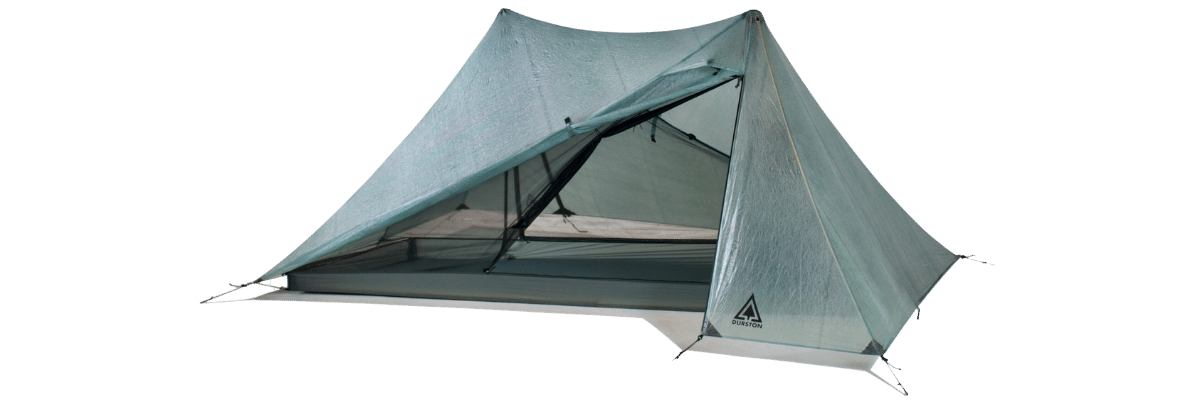
The Durston X-Mid Pro 1 is the easy answer for ultralight solo backpackers who want a sub-pound DCF shelter that actually feels like a tent rather than a coffin with a door. Its patented offset twin-pole geometry is the real story here, giving you genuine sit-up headroom, two doors, two vestibules, and a 90-inch floor that fits hikers up to roughly 6 feet 8 inches. The main tradeoff is honest: you need two trekking poles, you need to learn the pitch, and you need to be comfortable spending what a used kayak costs on a tent.
Pros
- True dual-door, dual-vestibule layout in a sub-1-pound shelter
- Spacious enough for tall sleepers and wide pads
- Simple 4-corner pitch with no mandatory guylines
- Hot-bonded DCF seams and reinforced bias-aligned panels
Cons
- Requires two trekking poles (or buy carbon poles separately)
- DCF floor option adds cost and packed bulk
- Single-wall design means condensation is on you to manage
- Lead times and stock can be inconsistent
Bottom line: roughly $599 to $654 USD, 15.5 to 17.1 oz / 440 to 485 g trail weight, sleeps one.
Specs at a Glance: X-Mid Pro 1
| Spec | Value |
|---|---|
| Price (USD) | $599 (silnylon floor) / $654 (DCF floor), verify current pricing at Durston |
| Trail Weight | 440 g / 15.5 oz (DCF floor) or 485 g / 17.1 oz (silnylon floor) |
| Packed Weight (with stuff sack, 5 stakes) | 500 g / 17.6 oz (DCF) or 550 g / 19.4 oz (silnylon) |
| Capacity | 1 person |
| Floor Dimensions | 90 x 32 in / 229 x 81 cm |
| Floor Area | 20 sq ft / 1.9 sq m |
| Peak Height | 45 in / 114 cm |
| Fly Footprint | 63 x 98 in / 160 x 259 cm |
| Vestibule Area | 22 sq ft / 2 sq m (11 sq ft each side) |
| Packed Size | 10 x 4.5 in / 25 x 12 cm |
| Shelter Type | Single-wall (hybrid) trekking pole tent |
| DCF Canopy Weight | 0.55 oz/sqyd Dyneema Composite Fabric |
| DCF Floor Weight | 0.67 oz/sqyd DCF (or 15D Sil/PEU nylon as alternative) |
| Number of Doors | 2 |
| Number of Vestibules | 2 |
| Wall Construction | Hot-bonded seams, reinforced bias-aligned panels |
| Season Rating | 3-season |
| Trekking Poles Required | Yes, 2 poles (or 2 dedicated tent poles sold separately) |
| Warranty | 2 years |
| Lead Time | Varies, check Durston site for current stock status |
Durston Gear X-Mid Pro 1 Design and Build Quality
The X-Mid Pro 1 uses 0.55 oz/sqyd DCF for the canopy and gives you a choice between a 15D silnylon/PEU floor or a clever 0.67 oz/sqyd DCF floor that uses a thicker 0.18 mil mylar layer on the ground side and a thinner 0.08 mil layer facing the interior. This is not just an off-the-shelf floor spec, it is engineered to land between standard 1.0 oz DCF (heavier, bulkier) and the ultra-thin 0.5 oz stuff that tears looking at a pinecone.
Construction is hot bonded, not sewn or cold taped. That matters because bonded DCF seams stay stronger across temperature swings and look cleaner over time. Durston also uses a proprietary pre-shrinking process so the canopy does not deform or pucker zippers after a few wet-dry cycles, and stress lines are aligned with the Dyneema fibers so panels are never loaded diagonally on the bias.
The hardware is the small stuff that pays off in year three. YKK #3 AquaGuard zippers on the fly, standard YKK #3 on the inner, Dyneema-core guylines with a polyester sheath and reflective tracer, LineLocs preinstalled, magnetic door toggles, and reinforced peak panels that accept up to 12 stake-out points in storm mode plus peak and side panel guylines. Bathtub corners are tensioned so the floor lies flat rather than sagging. For a sub-pound shelter, almost nothing here was decontented to hit the weight target.
Setup and Pitch of the X-Mid Pro 1
This is where the X-Mid Pro 1 separates itself from the pack. The 90-inch floor length combined with 45-inch peak height and steep end walls means you actually have usable space at both ends. CleverHiker’s 5’11” tester reported plush head and foot clearance on a 2.5-inch pad with a 20-degree quilt, and Durston rates the shelter for hikers up to 6’8″. That is a real number, not marketing rounding.
The 32-inch floor width accommodates wide pads with room left over for a phone, glasses, and a water bottle without crowding your face. The offset twin-pole geometry is the trick that makes this work. Instead of one center pole eating your headroom and blocking the doorway, two poles sit on opposite corners of a diagonal ridgeline. That gives you sit-up room across more of the interior, not just under a single apex.
Two side doors with two vestibules is a big deal in a one-person tent. You get a dry door regardless of which way the wind shifts, and 22 square feet of total vestibule space (11 per side) swallows a pack, wet shoes, and a cook kit with room left. Two interior pockets handle the small stuff. Doorways open without being blocked by trekking poles, and the protected awning design keeps rain off the floor even when the doors are open.
The honest catch: it is still a one-person tent. Two people fitting in a pinch will not be comfortable.
Weather Performance of the Durston Gear X-Mid Pro 1
The X-Mid pitches with four stakes in a rectangle, no measuring, no estimating odd angles, no struts. Stake the four corners, slide in your trekking poles handle-up at the two reinforced peaks, and tension the LineLocs. CleverHiker reports pitching it under a minute with practice. First-time users typically need a few attempts to get the rectangle truly square, which is the only step that matters for a taut pitch.
Trekking pole length: the design works well with standard adjustable poles. If you do not hike with poles, Durston sells dedicated carbon Z-flick poles (3.1 oz each) or you can use fixed-length carbon poles to save more weight.
DCF behavior is a feature here. Unlike silnylon, DCF does not stretch when it gets wet, so a pitch that is drum-tight at sundown is still drum-tight at 3 a.m. when condensation has soaked the fly. You will not be crawling out in your boxers to re-tension guylines.
The flip side of zero stretch is that your rectangle needs to be right the first time. Pitch it crooked and you cannot pull the fabric into shape, you have to re-stake. On uneven ground, the X-Mid handles slope reasonably because the four corners are independent, but rocky sites with poor stake purchase are where most users struggle.
Beginner-friendliness is genuinely high for a trekking pole tent. The simple footprint, lack of mandatory guylines, and forgiving rectangular shape make it easier to learn than most pyramid or mid-style shelters. You can also pitch fly-first to keep the inner dry in rain, which is rare at this weight.
Durston Gear X-Mid Pro 1 Value and Comparisons
The X-Mid Pro 1 was tested by CleverHiker over 1,000 miles of the Pacific Crest Trail with no rips, tears, punctures, zipper jams, or cord failures. Backpacker has tested it on the Art Loeb Trail in the Pisgah National Forest and on the Colorado Trail through snow and hail. Real users on the Continental Divide Trail and Pacific Northwest Trail report strong performance in sustained mountain weather.
Rain shedding is excellent thanks to DCF’s 15,000 mm hydrostatic head rating and fully-taped bonded seams. The fly extends to ground level rather than being trimmed for weight, so rain splatter and wind-driven drafts are blocked. You can also raise the fly higher in fair weather for ventilation, or stake it down tight in storm mode with up to 12 stake points plus peak and side guyouts.
Wind resistance benefits from the low-profile geometry, the diagonal ridgeline that resists lateral collapse, and the option to add side panel guylines. Manufacturer-published mph ratings are not provided, but real-world reports from exposed alpine and tundra environments are consistently positive.
Condensation is the honest weakness. This is a single-wall tent, and DCF does not breathe. Dual adjustable peak vents help, and the mesh perimeter around the bathtub floor provides cross-flow, but in still, humid conditions you will get interior moisture. The good news is DCF does not absorb water like silnylon, so morning condensation wipes off easily with a bandana. Bathtub floor height is roughly 6 inches, enough to keep splashback and sheet flow out.
X-Mid Pro 1 Value and Comparisons
At $599 to $654, the X-Mid Pro 1 sits in the middle of the premium DCF tier. Three shelters are the obvious cross-shop:
Zpacks Plex Solo ($599): the Plex Solo weighs 13.9 oz in standard trim, almost 2 oz less than the silnylon-floored X-Mid Pro 1, and uses a stronger 1.0 oz/sqyd DCF floor. It pitches with a single trekking pole and six to ten stakes. The tradeoff is a single door, a single vestibule, and a pyramid-style shape that tapers at the head and foot (38″ wide at center, 28″ at the ends). If you are short on pack weight obsession and do not mind a tighter, lower-volume interior, the Plex Solo wins on raw grams. The X-Mid Pro 1 wins on livability, dual doors, and ease of pitch.
Zpacks Plex Solo Lite ($599): at 11.8 oz, this is the lightest credible solo DCF tent on the market, using a 0.75 oz floor and skinnier 1.3 mm guylines. Adventure Alan and other reviewers caution against it for thru-hikes due to the thinner floor. Pick this only if you are a fastpacker or weekend warrior chasing the lightest possible kit and willing to baby it.
Tarptent Aeon Li (around $599): the Aeon Li weighs 15.8 oz with a single-pole pitch and clever PitchLoc carbon strut corners. It has one door, one vestibule, and a 224 cm floor. Tarptent’s reputation for customer service is excellent. The X-Mid Pro 1 still has the edge on interior volume and the two-door convenience, but the Aeon Li pitches with a single pole, which matters if you only carry one trekking pole.
Who should choose the X-Mid Pro 1:
- Thru-hikers who want maximum livability per ounce on long trails
- Tall sleepers (6 feet and up) who get crammed in most sub-pound shelters
- Hikers who hate fiddling with complicated pitches and want a 4-stake rectangle they can throw down in the dark
- Anyone who wants two doors and two vestibules in a single-person DCF tent, which is a rare combination
Who should look elsewhere:
- Single-trekking-pole users chasing the absolute lightest setup (look at Plex Solo or Aeon Li)
- Hikers who want a freestanding pitch (look at the upcoming Durston X-Dome Pro 1+)
- Anyone who cannot stomach single-wall condensation management
X-Mid Pro 1 by Durston Gear FAQ
Is the Durston X-Mid Pro 1 good in heavy rain?
Yes. The DCF canopy has a 15,000 mm hydrostatic head, the seams are hot-bonded (not just sewn and taped), and the full-coverage fly extends to ground level. Field-tested over thousands of trail miles including the PCT and Colorado Trail with no leakage reports.
How hard is it to set up for beginners?
Easier than most trekking pole tents. The 4-corner rectangular pitch has no mandatory guylines, no struts, and no odd angles to measure. Most users get a clean pitch by the third or fourth attempt. The main learning curve is making sure your rectangle is truly square before inserting the poles.
Can the X-Mid Pro 1 handle strong winds?
It handles real mountain weather well thanks to the low diagonal-ridgeline geometry and up to 12 available stake points plus peak and side panel guyouts for storm mode. Users have ridden out winter conditions in it. Specific mph ratings are not published, but reviewer and user reports align with Tarptent Aeon Li and Zpacks Plex Solo for storm-worthiness.
Do I need a footprint for the DCF floor?
Not strictly required. DCF is highly tear-resistant. CleverHiker’s 1,000-mile PCT test produced no punctures, only impression marks from a granite rock under the shoulder area. If you frequently camp on sharp rock or thorny ground, a polycryo groundsheet adds about 2 oz of insurance.
Is the X-Mid Pro 1 good for tall hikers?
Yes, exceptionally so. The 90-inch floor length combined with 45-inch peak height and steep end walls accommodates sleepers up to 6 feet 8 inches per Durston’s specs. This is one of the most genuinely tall-friendly sub-pound tents available.
How bad is condensation in the X-Mid Pro 1?
It is a single-wall DCF tent, so condensation is real in humid, still conditions. Dual adjustable peak vents and the mesh perimeter help significantly. DCF does not absorb water, so morning moisture wipes off easily. If you regularly camp in cold valley bottoms or river basins, expect to manage it actively.
Is the DCF floor or silnylon floor the better choice?
The DCF floor saves about 1.6 oz and resists tears better. The silnylon floor packs smaller, costs less, and resists abrasion better. CleverHiker recommends the silnylon floor for most users on cost and packed-size grounds. Thru-hikers chasing every gram go DCF.