
X-Mid Pro 2 Quick Take
The Durston X-Mid Pro 2 is built for the thru-hiker or fastpacker who wants the lightest possible two-person shelter without giving up storm protection or living space. Its standout strength is the patented X-Mid geometry, which delivers best-in-class headroom and a genuinely simple four-stake pitch in a tent that weighs barely over a pound. The main tradeoff is the one shared by every Dyneema shelter: you are paying a steep premium for a fabric whose lifespan is often measured in a single thru-hike, and as a single-wall design it demands attention to condensation.
Pros
- Simple four-stake pitch with no mandatory guylines and no poles blocking the doors
- Class-leading headroom and a full-coverage fly that drops to the ground to block splatter
- Roughly a pound lighter than the silnylon X-Mid 2 while staying storm-worthy
- Smaller packed size than most DCF tents thanks to the woven floor option
Cons
- Single-wall construction means condensation needs active management
- DCF lifespan is limited and the price is high for the durability you get
- The large footprint and need for a square pitch can be fiddly on tight or uneven sites
- Returns to Canada can be expensive for US buyers
Bottom line: $679 for a 21 oz (595 g) typical setup, two-person, three-season Dyneema trekking-pole shelter that is hard to beat on the weight-to-livability ratio.
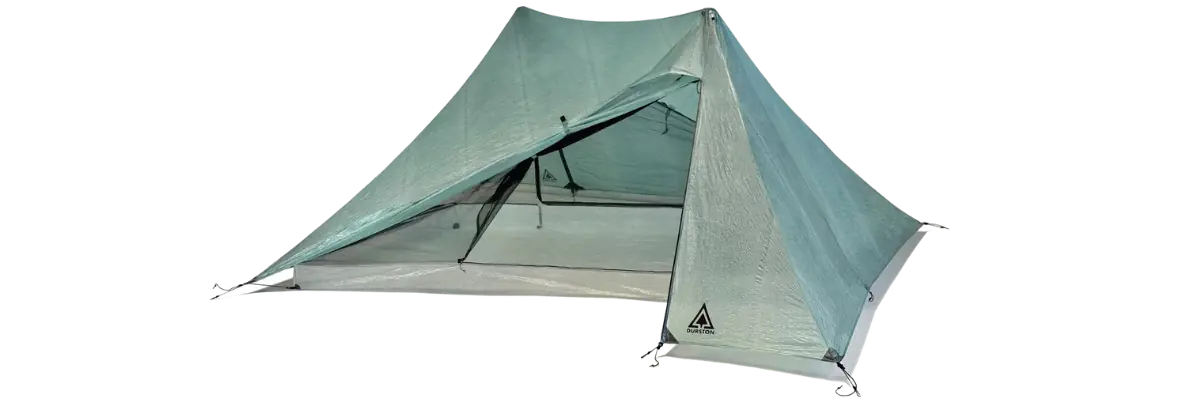
Specs at a Glance: X-Mid Pro 2
| Spec | Detail |
|---|---|
| Price (USD) | $679 (woven floor, stakes not included); roughly $789 with Dyneema floor |
| Trail Weight | 509 g / 17.9 oz (Dyneema floor) or 565 g / 19.9 oz (silnylon floor), tent only |
| Packed Weight | 595 g / 21.0 oz (Dyneema floor, sack, 6 stakes) or 655 g / 23.1 oz (silnylon floor setup) |
| Capacity | 2 person |
| Floor Dimensions | 90 x 46 in / 229 x 117 cm (28.75 sq ft floor area) |
| Peak Height | 46 in / 117 cm |
| Packed Size | 11 x 5 in / 27 x 12 cm |
| Shelter Type | Single-wall hybrid trekking-pole tent |
| DCF Canopy Weight | 0.55 oz/sqyd |
| DCF Floor Weight | 0.66 oz/sqyd (Dyneema floor option); standard floor is 15D sil/PEU nylon |
| Number of Doors | 2 |
| Number of Vestibules | 2 (11.6 sq ft each, 23 sq ft total) |
| Wall Construction | Hot-bonded seams, pre-shrunk DCF, bias-aligned stress lines |
| Season Rating | 3 season |
| Trekking Poles Required | Yes (two) |
| Warranty | 2 years |
| Lead Time | Not specified |
Durston Gear X-Mid Pro 2 Design and Build Quality
The canopy is 0.55 oz/sqyd Dyneema Composite Fabric, the same lightweight grade used on the standard Zpacks Duplex, paired with your choice of a 15D woven sil/PEU nylon floor or an upgraded 0.66 oz/sqyd DCF floor. Durston rates the DCF as waterproof to 15,000 mm, and the non-elastic fabric holds tension in the wet without the overnight sag you get from silnylon.
What justifies the price here is not the amount of Dyneema, it is the construction. Durston uses hot-bonded seams rather than sewn or cold-taped ones, which are cleaner and hold strength better in temperature extremes. The company also runs a proprietary pre-shrinking process so the shape stays stable and the zippers do not go wavy over time, a known failure mode on cheaper DCF tents. Stress lines are deliberately aligned with the Dyneema fibers or reinforced with DCF tape to avoid loading the fabric on the bias, which prolongs lifespan.
Hardware is sensible rather than flashy. Fly zippers are YKK #3 AquaGuard, inner zippers are YKK #3, and the doors use magnetic toggles for one-handed operation. The bathtub floor is tensioned by small corner struts and cords so it lies taut instead of hanging like a bag. The tent pitches with four stakes, with peak and side-panel guyouts plus up to twelve base stakes available for storm conditions. It is a thoughtfully detailed shelter, though the woven floor is the smart pick for most buyers since durability between the two floors is similar.
Setup and Pitch of the X-Mid Pro 2
The floor is 90 in long and 46 in wide (229 x 117 cm) with a 46 in (117 cm) peak. The clever part is the geometry: a diagonal ridgeline crossing an opposite diagonal floor creates headroom where you actually sit up, and the steep end walls add usable length. Durston quotes an inside-fly length of 106 in because you sleep at about a 20-degree angle to the fly.
For tall sleepers, Durston recommends the tent up to 6 ft 4 in for two people and up to 7 ft 0 in solo, with the taller person taking the steeper headwall side. That is an honest estimate rather than an inflated one, and real-world results vary with pad thickness and how fussy you are about space.
The two vestibules are large at 11.6 sq ft each, and crucially they sit beside the doorway rather than blocking it, so you can get in and out without crawling over gear. Each side has an interior pocket. The honest catch is width. Two wide pads only fit with effort, by pitching low and splaying the walls or placing pads opposite ways. If you and a partner both run wide pads regularly, the wider X-Mid Pro 2+ is the better buy. Solo, this thing is a palace.
Weather Performance of the Durston Gear X-Mid Pro 2
This is where the X-Mid earns much of its reputation. The rectangular base means a simple four-stake pitch with no measuring, no odd angles, and no mandatory guylines. You stake the four corners, insert two trekking poles, and you are essentially done. Most people get a clean pitch on the first or second try, and one owner reported setting it up in their basement before a trip and finding it genuinely intuitive.
Trekking poles are required. Durston does not publish a single fixed pole length because pole height interacts with how high or low you pitch the fly, so plan to adjust your poles on site rather than dialing in one number. The DCF fabric does not stretch, which cuts both ways. You never need to re-tension it overnight the way you do with silnylon, but it also will not forgive a sloppy pitch, so getting the corners square matters.
That square requirement is the real learning curve. On sloped or uneven ground it can take a couple of tries to get the 90-degree geometry right, and the stock guylines are short. Several long-term users carry a bit of extra line and two spare stakes to pull out the center end panels for airflow and to deploy the peak guyouts in hard weather. The large footprint can also be tricky to fit on tight pads. For a trekking-pole tent, though, this is about as beginner-friendly as the category gets.
Durston Gear X-Mid Pro 2 Value and Comparisons
The X-Mid shape is genuinely good in wind. There are no horizontal roof panels to catch snow and no vertical walls to catch gusts, just consistent moderate slopes. One long-term tester used it in winds up to roughly 30 mph (48 kmh) with steep walls shedding rain and snow well and no zipper leaks. The honest caveat is that the large side panels can bow inward in strong gusts unless you fully guy them out, so the stock four-stake pitch is for fair weather and the eight-plus stake storm mode is what you deploy when it turns.
Rain shedding is a strength. Because the full-coverage fly drops all the way to the ground, it blocks the splatter and drafts that high-cut competitors let in, and the protected doorways keep rain off the floor even when open. The tradeoff in driving shoulder-season rain is real: pitch the fly low to stop splashback and you reduce airflow, pitch it higher for ventilation and you risk some splatter.
Condensation is the headline weakness, and it is inherent to single-wall DCF, not a Durston flaw. The dual strut-held peak vents and continuous mesh perimeter manage it better than most single-wall tents, and in dry or breezy conditions many users report no issues. But with two people in near-freezing, humid conditions, expect to wipe down the interior in the morning. Keeping a door or the vents open is the key, and a small camp towel earns its place.
X-Mid Pro 2 Value and Comparisons
At $679, the X-Mid Pro 2 sits in the thick of the premium DCF field, so the question is which of the obvious rivals fits your use case.
Versus the Zpacks Duplex ($699 to $799 depending on version). The Duplex is the trail icon, made in the USA, and ubiquitous on the AT, PCT, and CDT. It weighs about the same, around 18 to 19 oz. The practical difference is livability and pitch. Reviewers who have used both tend to give the X-Mid the edge on headroom, on doors that are not blocked by poles, and on storm-worthiness, thanks to the more aerodynamic shape and a fly that reaches the ground to stop splashback. The Duplex counters with US-based manufacturing, faster shipping, easier domestic returns, and a slightly more refined symmetrical pitch on the newer Pro version. If buying American and painless service matter most, the Duplex wins. If you want the most interior space and storm protection per gram, the X-Mid does.
Versus the Zpacks Duplex Lite ($670). The Lite is the gram-counter’s answer at roughly 15.9 oz, lighter than the X-Mid by a couple of ounces. But it achieves that with lighter, more delicate fabric and less all-weather robustness. This is the choice for fastpackers and FKT attempts in good weather where every ounce counts. For a multi-week thru-hike through mixed conditions, the X-Mid’s extra protection is worth the small weight penalty.
Versus the standard silnylon X-Mid 2 ($319 to around $369). Same geometry, same livability, double-wall construction, and far better durability for daily use, at roughly a pound heavier and less than half the price. If your budget is tight or you prioritize a long service life over weight, the standard X-Mid is arguably the smarter buy, and you can pocket the savings.
Who should choose the Pro? The thru-hiker or fastpacker who has decided that a sub-pound-and-a-half shelter is worth a premium and a finite lifespan, who wants the easiest pitch and most headroom in the DCF class, and who is willing to manage condensation. Everyone else is better served by the standard X-Mid 2 or, for absolute weight, the Duplex Lite.
X-Mid Pro 2 by Durston Gear FAQ
How does the X-Mid Pro 2 handle wind and rain?
It performs well above its weight in storms because the sloped geometry resists wind and snow loading, and the full-coverage fly blocks rain splatter that high-cut tents let through. In strong gusts the side panels can bow in, so deploy the peak and side guyouts rather than relying on the four-stake pitch when weather turns.
Is the X-Mid Pro 2 hard to set up?
No, it is one of the easier trekking-pole tents to pitch, using just four stakes with no measuring or mandatory guylines. The only real skill is getting the rectangular base square, which can take a couple of tries on sloped or uneven ground.
Does the X-Mid Pro 2 have a condensation problem?
Like all single-wall DCF tents, yes, it can collect condensation, especially with two people in cold, humid conditions. The dual peak vents and mesh perimeter manage it better than most, but you should keep vents or a door open and carry a small towel to wipe down in the morning.
Is the Dyneema worth it over the standard X-Mid 2?
Only if weight is your priority. The Pro saves close to a pound but costs roughly double and has a more limited fabric lifespan, often around 100 to 200 nights of hard use. The silnylon X-Mid 2 offers the same design and better durability for far less money.
Does the X-Mid Pro 2 fit two people and two wide pads?
It fits two people comfortably up to about 6 ft 4 in when sleeping the same direction. Two wide pads only fit with effort by pitching low and splaying the walls, so frequent wide-pad users should look at the larger X-Mid Pro 2+.
Do I need a footprint or groundsheet?
Durston says a groundsheet is not required for either floor option when used with care, though roughly half of owners use one for added protection and to keep the floor clean. Consider one if you camp on rocky or abrasive surfaces or do not want to inspect every site for sharp objects.
How long will the Dyneema fabric last?
DCF slowly fatigues under tension, so the practical lifespan is commonly cited as about one thru-hike, roughly 100 to 200 nights depending on how tightly you pitch it. Durston reinforces seams and peak points to extend life, but high-tension pitches in repeated wind and rain will wear it faster.
Note: this is a research-based review compiled from the manufacturer’s specifications and published field reviews. If sensitive personal decisions ride on long-term durability, weigh the documented DCF lifespan carefully against your expected use.