
Duplex Pro Quick Take
The Zpacks Duplex Pro is the iterative upgrade to the most copied ultralight tent in the world, and it’s aimed squarely at thru-hikers who already carry trekking poles and treat ounces like currency. Its standout strength is the rare combination of a sub-20-ounce trail weight with a fully symmetrical, twin-door, twin-vestibule layout that two adults can actually live in for months. The main tradeoff is the price. At $799 for the Lite build, you are paying a serious premium for DCF and a brand pedigree, and you still get the inherent limitations of any single-wall A-frame: some condensation, drafts in cold storms, and a non-freestanding pitch.
Pros
- Genuinely sub-1.5 lb trail weight in the Lite build
- Fully symmetrical pitch with twin doors and twin vestibules
- Zippered storm doors with peak vents are a real upgrade over the Classic
- DCF does not sag, stretch, or absorb water
Cons
- $799 entry price for the Lite, more for Standard
- 84 inch interior length feels tight for sleepers 6 feet and up
- Single-wall design means condensation management is on you
- Trekking pole tent, no good on platforms or rock without the Flex Kit
One-line summary: $799, 19.2 oz / 544 g trail weight in Lite build, two-person capacity.
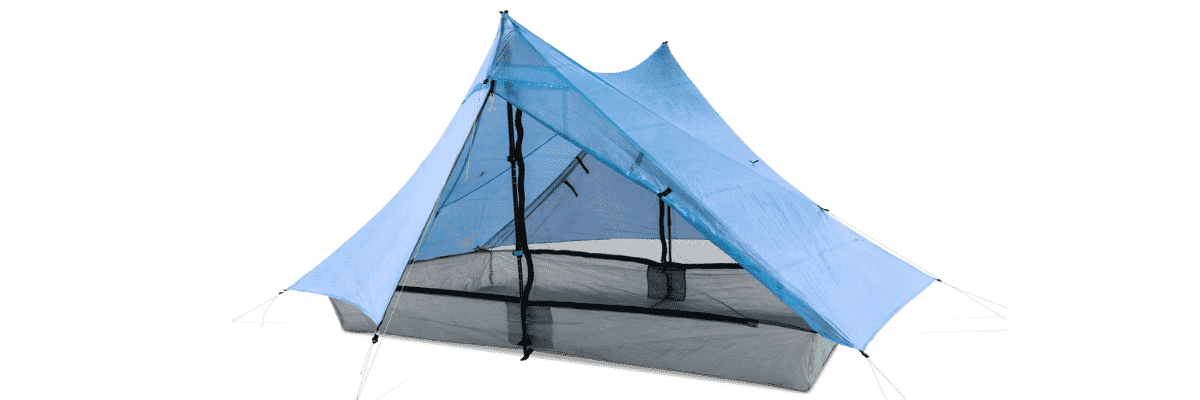
Specs at a Glance: Duplex Pro
| Spec | Value |
|---|---|
| Price (USD) | $799 (Lite), $799 (Standard, same listed price) |
| Trail Weight | 544 g / 19.2 oz (Blue or Olive Drab Lite) |
| Packed Weight | ~561.5 g / 19.8 oz (with stuff sack, repair tape, spare zipper sliders) |
| Capacity | 2 person |
| Floor Dimensions | 84 x 50 in / 214 x 127 cm |
| Peak Height | 48 in / 122 cm |
| Packed Size | 5 x 12 in rolled tight / 12.7 x 30.5 cm (236 cubic in / 3.9 L) |
| Shelter Type | Single-wall, trekking pole, A-frame, two-door |
| DCF Canopy Weight | 0.55 oz/sqyd (Lite) or 0.75 oz/sqyd (Standard) |
| DCF Floor Weight | 0.75 oz/sqyd (Lite) or 1.0 oz/sqyd (Standard) |
| Number of Doors | 2 mesh doors + 4 independent storm door panels |
| Number of Vestibules | 2 (with 4 panels total, each can roll independently) |
| Wall Construction | Single-wall DCF with bonded taped seams |
| Season Rating | 3-season |
| Trekking Poles Required | Yes, 2 poles at 48 in / 122 cm |
| Warranty | Lifetime against manufacturing defects (per Zpacks warranty policy) |
| Lead Time | Ships in 1 to 3 business days |
| Stakes Required | 6 to 8 (not included) |
A quick note on Standard floor pricing: the Spruce Green Standard build is listed at the same $799 base on the product page at the time of this review, with the only displayed difference being a heavier 627 g weight. Confirm with Zpacks at checkout if you are choosing the Standard fabrics.
Zpacks Duplex Pro Design and Build Quality
The Duplex Pro is essentially the proven Duplex Classic with a handful of meaningful upgrades. The headline change is the zippered storm doors with peak vents, which give you four independent panels you can roll up, magnet-toggle, or zip shut. That alone changes the calculus in shoulder-season weather, because the original Duplex’s overlapping vestibule doors never sealed cleanly.
Fabric choice is where Zpacks lets you tune the build. The Lite version pairs a 0.55 oz/sqyd DCF canopy with a 0.75 oz/sqyd DCF floor, which is what gets you to the headline 19.2 oz trail weight. The Standard version moves to 0.75 oz canopy and 1.0 oz floor, adding opacity and durability at the cost of about 3 extra ounces. Both use bio-based Dyneema fiber, both are PFAS-free, and both come with bonded taped seams so you never need to seam seal.
Hardware details are honest premium. Zippers are #3 YKK with field-replaceable sliders, and Zpacks includes two spare sliders plus 54 inches of DCF repair tape in the box. Guylines are bright yellow 1.6 mm Z-Line, easy to see at night, and the LineLoc V tensioners are sewn in at the corners and tieouts. The bathtub floor has 8 inch walls and sits 6 inches off the ground, which is unusually tall and pays off in splashy rain.
If you are asking whether this tent justifies $799, the materials and construction story checks out. What you cannot get from a cheaper tent is the combination of bonded seams, DCF’s no-stretch behavior, and the sub-20-ounce weight in one package.
Setup and Pitch of the Duplex Pro
The interior is 84 inches long and 50 inches wide, with a 48 inch peak. That floor is genuinely wide enough for two 25-inch wide sleeping pads side by side, which is a meaningful upgrade over older A-frame two-person tents that pinched at the foot. The symmetrical design means there is no head end and foot end, just two ends, and either one can face the wind.
Where the Duplex Pro will frustrate you is length if you are tall. At 84 inches of interior floor, you have just 7 feet end to end before the bathtub wall starts. Reviewers at 5 foot 10 report their sleeping bag footbox touching the canopy, and that contact gets miserable on wet nights when condensation has formed on the inside of the fly. If you are 6 feet or taller, look hard at the DupleXL or the taller Pivot Duo before committing.
The two-door, two-vestibule layout is where this tent shines for partners. Each person gets their own entry, their own gear storage, and their own zipper, so nobody has to crawl over anyone in the middle of the night. Vestibule depth is 21.5 inches per side, which is enough for a pack and shoes but not generous. The peak height is high enough that two adults can sit up at the center without brushing the canopy.
Interior storage is the weak spot. There are mesh pockets near each screen door, accessible from inside or outside, but no overhead loops or pockets for glasses, phones, or a headlamp. Reviewers consistently flag this, and Zpacks sells add-on pockets separately, which feels stingy at this price.
Weather Performance of the Zpacks Duplex Pro
If you have pitched any trekking pole A-frame before, the Duplex Pro will feel familiar. Adjust your two poles to 48 inches, stake the four corners at roughly 45 degree angles, insert the poles under the peaks, stake the two end guylines, then walk the corners and tieouts to dial in tension. Expect 5 to 10 minutes once you have done it a few times. The symmetrical layout removes a real source of pitch frustration: you do not have to figure out which end goes where.
DCF’s defining behavior is that it does not stretch, which has two practical consequences. The first is that a properly pitched Duplex Pro stays drum-taut all night, even in heavy rain, with no midnight re-tensioning. The second is that DCF is less forgiving of a sloppy pitch than silnylon. If a corner is off, the fabric will not stretch to hide it, and you will see wrinkles and slack panels until you reset the stake. Learning to read the panels and adjust corners takes a couple of nights.
On uneven ground, the Duplex Pro is workable but not magical. You can angle the poles slightly to compensate for slope, and the corners give you some tolerance, but rocky or rooted sites will frustrate you the same way they frustrate any non-freestanding tent. On hard-packed surfaces, Zpacks recommends lowering the trekking poles slightly because the pole tips will not sink in the way they would in dirt.
Beginner friendliness is moderate. It is easier to pitch than offset designs like the StratoSpire, harder than a freestanding dome. Bring eight stakes, not six, the first few times you set this up. The two end guylines are not optional in wind.
Zpacks Duplex Pro Value and Comparisons
For an A-frame trekking pole tent, the Duplex Pro punches above its weight class. Reviewers consistently report it handling sustained wind and gusts well, with the DCF staying taut and the stakes holding even on partially frozen ground. Point one of the storm doors into the wind, zip everything down, and you get a much more secure shelter than the Classic offered.
Rain shedding is excellent because DCF is inherently waterproof with no DWR coating to wear off, and the bonded seams do not need sealing. In one Switchback Travel test, the tent kept a steady rain at bay all night and stayed taut while soaked. Where rain gets in is the gap between the vestibule doors and the ground, which is intentional. The fly sits about 6 inches off the ground for airflow, which means driving rain can splash up through the mesh if you are on hard-packed ground and have not used the bathtub-friendly campsite Zpacks recommends (leaves or pine needles).
Condensation is the honest weakness of any single-wall DCF tent, and the Duplex Pro is no exception. In humid or cold conditions, you will get moisture on the inside of the canopy. The four independently rolling door panels and the peak vents help significantly, and most reviewers describe condensation as manageable rather than severe. The trick is leaving at least one downwind panel open whenever weather allows. Pack a small trail towel to wipe the interior in the morning.
Storm mode is straightforward. Zip all four panels closed, point the doors into the wind, tension every guyline. It is a 3-season shelter and Zpacks does not market it otherwise. For exposed alpine ridges in genuine winter conditions, look at a pyramid tent like the Hyperlite Ultamid 2.
Duplex Pro Value and Comparisons
The Duplex Pro lives in a tight competitive space at the top of the DCF two-person market. Three alternatives are worth weighing.
Durston X-Mid Pro 2 ($679 MSRP, 17.9 oz / 509 g) is the most direct competitor and the one that has reshaped this category. It is lighter, cheaper by $120, and uses more efficient geometry that gives it a smaller footprint relative to interior volume, plus a full-coverage fly that extends closer to the ground for better draft and splash protection. The tradeoff is the offset pole layout, which is slightly less intuitive to pitch and more sensitive to site selection. If raw weight, value, and stormworthiness are your top criteria, the X-Mid Pro 2 is hard to argue against.
Tarptent StratoSpire 2 Li ($679, ~29 oz) trades weight for better wind performance and larger vestibules thanks to its offset, four-corner geometry. It is roughly 10 ounces heavier than the Duplex Pro, but if you camp regularly in exposed terrain or expect serious storms, the StratoSpire’s pitch is more storm-stable. Setup is fiddlier and the footprint is larger.
Hyperlite Mountain Gear Ultamid 2 with insert (~$955 to $1,100, 32 to 36 oz) is in a different category entirely. The pyramid design sheds wind dramatically better than any A-frame, and it pulls double duty for shoulder season and light winter use. It is heavier, more expensive, requires a much larger footprint, and uses a center pole that some find awkward. Choose this if your trips push into nastier weather than the Duplex Pro is designed for.
Who should choose the Duplex Pro over these alternatives? Buyers who want the most refined version of the most-tested ultralight tent on the long trails, who value the symmetrical pitch (no thinking required at the end of a long day), who want twin doors and twin vestibules for two-person living, and who are willing to pay the Zpacks premium for the brand’s customer support and warranty. If you are pinching pennies, the X-Mid Pro 2 is the smarter buy. If you camp in serious weather, the Ultamid is the smarter buy. The Duplex Pro is the best choice when you want the default thru-hiker shelter, slightly improved.
Duplex Pro by Zpacks FAQ
Is the Zpacks Duplex Pro good in rain?
Yes, with one caveat. The DCF canopy is inherently waterproof, the bonded seams do not need sealing, and the fabric stays taut when wet. Splash-up through the perimeter gap is the thing to watch for on hard-packed ground, so pick campsites with leaves or pine needles where possible, or pair it with a Zpacks Flat Groundsheet that fits inside the bathtub.
How does the Duplex Pro handle wind?
Surprisingly well for an A-frame. Reviewers report it holding through sustained wind and significant gusts when pitched with the storm doors into the wind. It is not the equal of a true storm shelter like a pyramid, but for a 19 ounce two-person tent, the wind performance is among the best in class.
Is the Duplex Pro hard to set up?
Moderate difficulty. The symmetrical design removes a lot of guesswork because either end can face any direction, but DCF’s no-stretch behavior is less forgiving of a sloppy pitch than silnylon. Expect a few nights of practice before your pitch is consistently drum-taut.
Can two people really fit in the Duplex Pro?
Yes for width, with caveats for length. The 50 inch wide floor fits two wide pads side by side, and the twin-door, twin-vestibule layout means partners are not crawling over each other. The 84 inch length is the limit. If either of you is 6 feet or taller, look at the DupleXL.
Does the Duplex Pro have condensation problems?
Like every single-wall tent, yes, but it is well managed. The four independent door panels and peak vents give you serious ventilation options, and most reviewers describe condensation as minor and manageable. Leave at least one downwind panel cracked open and carry a small trail towel.
Do I need a groundsheet with the Duplex Pro?
Not strictly. The 0.75 oz DCF floor on the Lite build (or 1.0 oz on the Standard) is meant to be used without a separate groundsheet. A Zpacks Flat Groundsheet or a cheap polycryo sheet is a smart precaution for longevity, especially on a multi-thousand-mile thru-hike, but it is optional.
Is the Duplex Pro worth the $799 price?
Honest answer: it depends on how much you hike. For a thru-hiker spending 100+ nights in a tent, the weight savings, the proven design, and Zpacks’s customer support justify the premium. For weekend backpackers, the Durston X-Mid Pro 2 at $679 or even the standard X-Mid 2 at $319 will get you most of the way there for a fraction of the price.